
Client Overview
Our client is a leading international B2B foodservice wholesaler and distributor, supplying a vast network of hospitality businesses, retail stores, schools, and hospitals. As a major player in the food and goods-for-resale market, the business manages complex, multi-brand supply chains to deliver essential products across the United Kingdom.
Their business model is built on aggressive acquisition growth - continuously integrating specialist brands and regional distributors into a unified operational framework. This ambition, while commercially successful, created increasing strain on back-office functions ill-equipped for the resulting data complexity.
The Challenge
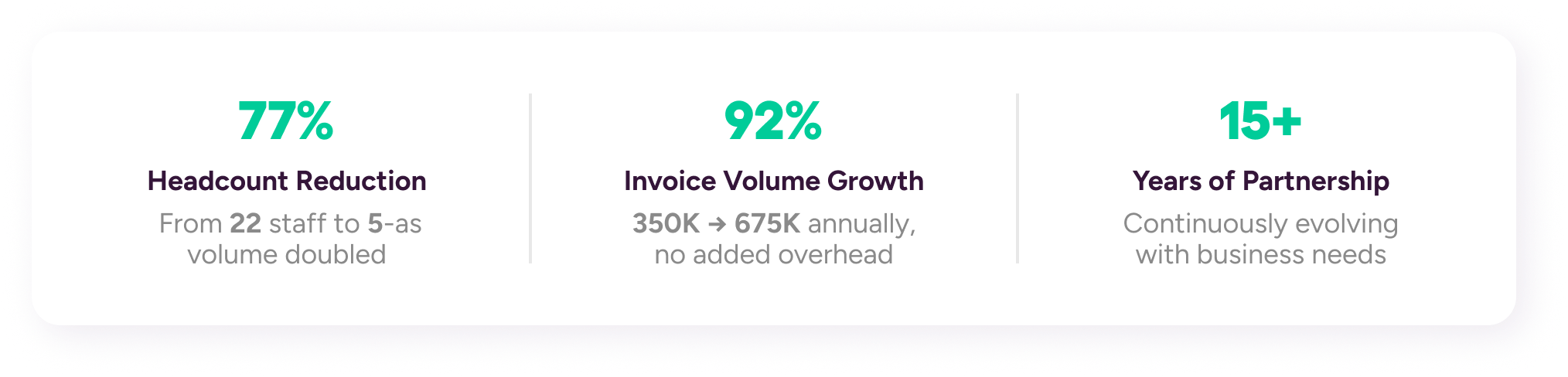
At the outset of organization's transformation journey, the organization faced a mounting administrative burden that threatened operational continuity. Processing approximately 350,000 inventory AP invoices annually required a team of 22 dedicated staff - a model that was neither sustainable nor scalable as acquisition pace accelerated.
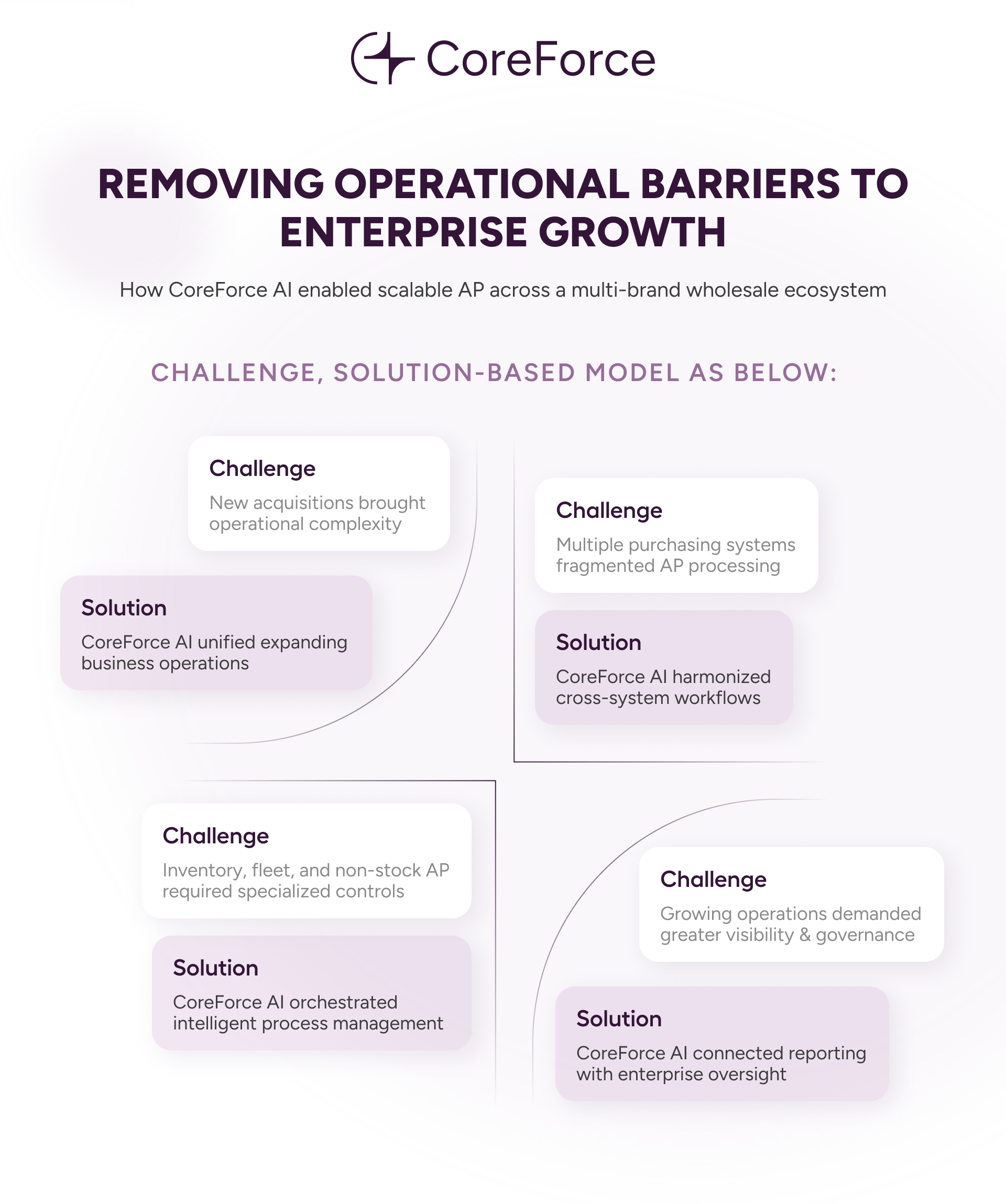
Acquisition-Driven Complexity
Each new brand acquisition brought its own purchasing systems, document formats, and depot-level business rules. Integrating these disparate data streams into a centralized AP function required constant manual intervention and customization with no structured framework to absorb the change.
Systemic Fragmentation Across Purchasing Platforms
Our client operated across multiple incompatible purchasing platforms simultaneously. Consolidating these into a single ERP was neither commercially viable nor operationally practical. What was needed was a software-agnostic automation layer capable of normalizing diverse data sources without forcing system consolidation.
Unsustainable Manual Scaling Model
Increases in invoice volume translated directly into headcount requirements. The linear relationship between workload and staffing was creating an escalating cost structure that eroded margins and introduced significant people-risk into a critical finance function.
UK Government Compliance Obligations
Mandatory adherence to the UK's Reporting on Payment Practices and Performance Regulations required faster, more accurate processing and detailed reporting - demands that the existing manual model could not meet consistently.
Fleet Management Visibility Gaps
Invoice matching for fleet operations was particularly problematic. Without structured alignment between invoices, purchase orders, and job tickets, overpayments and cost allocation errors were recurring issues that required reactive investigation rather than automated prevention.
Fragmented Non-Inventory AP
Beyond inventory, business's emerging PO Manager system created a new category of non-stock invoice complexity - requiring a centralized, department-governed approach to non-inventory AP that didn't yet exist.
Business Impact
By deploying CoreForce as its centralized AP intelligence layer, our customer achieved a transformation that extended well beyond process efficiency. What was once a high-cost, labor-intensive function becoming a lean, scalable, and compliance-ready operation - capable of absorbing acquisition growth without proportional cost increases.
Seamless Acquisition Integration
CoreForce's modular architecture enabled the rapid onboarding of new acquisitions and their unique purchasing systems with zero operational downtime. Each integration was absorbed into the existing automation framework without disruption to live processing workflows.
Software-Agnostic Data Harmonization
The platform normalized data from multiple incompatible purchasing systems simultaneously, eliminating manual data entry and the operational friction of toggling between platforms. Procurement teams operate within business's preferred tools while CoreForce handles the unification layer.
Enhanced Compliance and Cashflow Management
Advanced reporting suites provided the structured, auditable data required for mandated UK Government payment practice reporting - transforming compliance from a reactive exercise into an automated output.
Precision Cost Control Across Fleet Operations
A controlled exception and approval mechanism for fleet AP replaced the previous ad-hoc process. Invoices fully matched to purchase orders, and job tickets are processed automatically; discrepancies are escalated through structured depot-wide approval workflows - eliminating overpayments at source.
Solution Architecture
CoreForce operates as the end-to-end intelligence layer for the organization's AP function, managing receipt, extraction, enrichment, and complex approval workflows across four distinct operational verticals.
1. Inventory Invoice Processing at Depot Scale
The platform identifies and orchestrates the ingestion of dozens of disparate PO streams across the national depot network. CoreForce normalizes data from multiple incompatible document formats by depot and department for automated cost allocation - enabling straight-through processing (STP) for fully matched orders, with exception routing for discrepancies requiring human review.
2. Integrated Reporting Portals
Real-time data is delivered either as a backend integration feed for connected systems or through a purpose-built management portal offering on-demand visibility into processing status, exception volumes, and payment timelines. This dual-mode reporting supports both operational oversight and executive decision-making.
3. Fleet Management Invoice Orchestration
Invoices are released based on live job ticket status - ensuring that cost allocation is anchored to confirmed delivery and service records rather than invoice submission date. Depot-wide batch approval of matched discrepancies is automated, while unresolved exceptions are escalated through structured workflows.
4. Non-Stock Invoice Automation
A centralized, department-governed workflow for non-inventory AP invoices linked to the organization's PO Manager system provides originating departments with visibility and exception ownership - while maintaining centralized control, audit trails, and processing consistency.
Why CoreForce
CoreForce provides the technical stability and modular flexibility required by enterprise wholesalers operating in high-growth, acquisition-driven environments. The platform's ability to enforce highly specific depot-level business rules while sustaining straight-through processing velocity is what separates it from general-purpose document automation tools.
CoreForce transformed the AP department from a cost centre into a lean, data-driven operation - not by replacing existing systems, but by building the intelligent layer above them.
Beyond the technology, the long-term success of this account is anchored by a highly responsive, consultative delivery model. CoreForce acts as a strategic operations partner - working closely with stakeholders to ensure the platform evolves at the pace of the acquisition roadmap, not behind it.
Conclusion
This long-standing partnership with leading UK-based international B2B foodservice wholesaler demonstrates what a platform-first approach to AP automation delivers over time: not a one-time efficiency gain, but a continuously evolving capability that grows more valuable as business complexity increases.
By processing nearly double the original invoice volume with a fraction of the original team - while maintaining compliance, eliminating overpayments, and absorbing acquisition after acquisition - CoreForce has become a foundational component of this organization's operational infrastructure.
The result is a future-proof AP function that turns document complexity into a competitive advantage.
Get in touch now
If manual invoice processing, acquisition-driven complexity, or fragmented purchasing systems are creating bottlenecks in your wholesale operations - limiting your ability to scale or creating compliance risk - CoreForce can help. Talk to Our Team at info@coreforce.ai.
