Client Overview
Our client is a leading international B2B omnichannel distributor operating across Europe and North America, supplying business equipment and operational infrastructure to corporate and industrial customers at scale.
With operations spanning multiple entities, regions, and languages, organization manages large volumes of enterprise documents generated through ERP-driven workflows and legacy archival systems. As part of a structured modernization initiative, the business needed to transition away from a legacy optical archive environment - while preserving operational continuity, regulatory compliance, and document accessibility across its entire multilingual footprint.
The Transformation Challenge
What appeared on the surface to be a migration project revealed itself to be a far more complex document intelligence challenge.
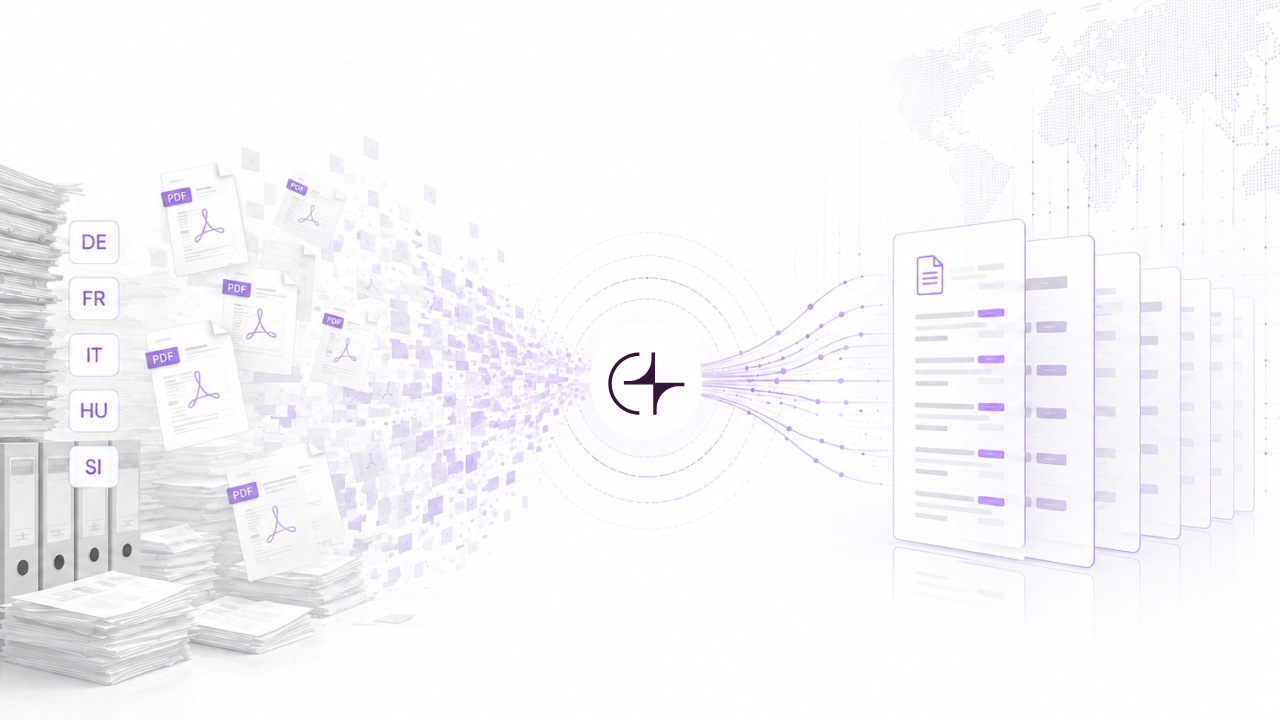
Our customer's archive ecosystem was built on ERP-generated PDF outputs stored in legacy optical infrastructure that lacked the structured metadata required for modern enterprise retrieval. Documents existed as unstructured, text-based PDFs - with varying layouts, regional formats, and language complexity - and no automated mechanism to extract, normalize, or index them at scale.
Key structural challenges included:
- Multilingual Processing Complexity: The archive spanned German, Slovenian, Italian, French, and Hungarian business environments - each with distinct document structures, regional formats, and language-specific extraction requirements.
- Absence of Structured Metadata: ERP systems produced PDF-only outputs with no embedded metadata, leaving archival documents effectively unsearchable without substantial manual intervention.
- Layout Variability Across Regions: Multiple document structures and regional formatting standards required flexible, adaptive extraction logic rather than template-dependent processing.
- Operational Continuity During Migration: Both historical and current documents needed to remain continuously accessible throughout a parallel migration environment - maintaining normal operations without service interruption.
- Manual Reconstruction Dependency: Metadata structuring and archival indexing relied on fragmented, labor-intensive manual processes that were neither scalable nor consistent across regions.
Without a structured, automated metadata framework, the organization faced retrieval inefficiencies, compliance exposure, operational disruption, and significant long-term accessibility risk.
How CoreForce AI Delivered the Transformation
CoreForce implemented an AI-powered archiving framework purpose-built for the organization's operational complexity - automating metadata extraction, normalizing document structures across languages, and enabling seamless parallel migration without disrupting live archive access.
CoreForce in Action:
- AI-Powered Metadata Extraction: CoreForce applied OCR processing combined with validation-driven extraction logic to automatically structure mandatory metadata fields from multilingual PDFs - without relying on pre-configured templates for each language or document type.
- Standardized XML Architecture: Extracted data was normalized into a unified XML schema, creating consistent metadata structures across all regions, entities, and document types within the archive ecosystem.
- Automated ERP Ingestion Framework: ERP-generated PDF outputs were ingested through controlled, secure source environments - eliminating the fragmented, manual intake processes that had previously introduced inconsistency and delay.
- Parallel Migration Enablement: Legacy and target archive environments operated simultaneously throughout the migration window, ensuring zero disruption to document accessibility for operational and compliance-sensitive workflows.
- Validation-Led Processing Workflows: Structured validation logic ensured metadata consistency, retrieval accuracy, and downstream integration readiness at every stage of the processing pipeline.
Business Outcomes
The CoreForce AI implementation enabled the organization to transition from a static, metadata-deficient archive environment to a structured document intelligence infrastructure - fully accessible, compliant, and built for long-term scalability.
- Structured Metadata Standardization: Normalized, searchable metadata was established across both historical and operational archives - unlocking retrieval capability that had not previously existed.
- Enhanced Document Accessibility: Retrieval performance and visibility improved significantly across all multilingual business environments and regional operations, reducing dependency on manual archive search.
- 70-80% Reduction in Manual Effort: Automated metadata extraction and structured ingestion eliminated the labour-intensive manual reconstruction work that had previously consumed substantial finance and operations resource.
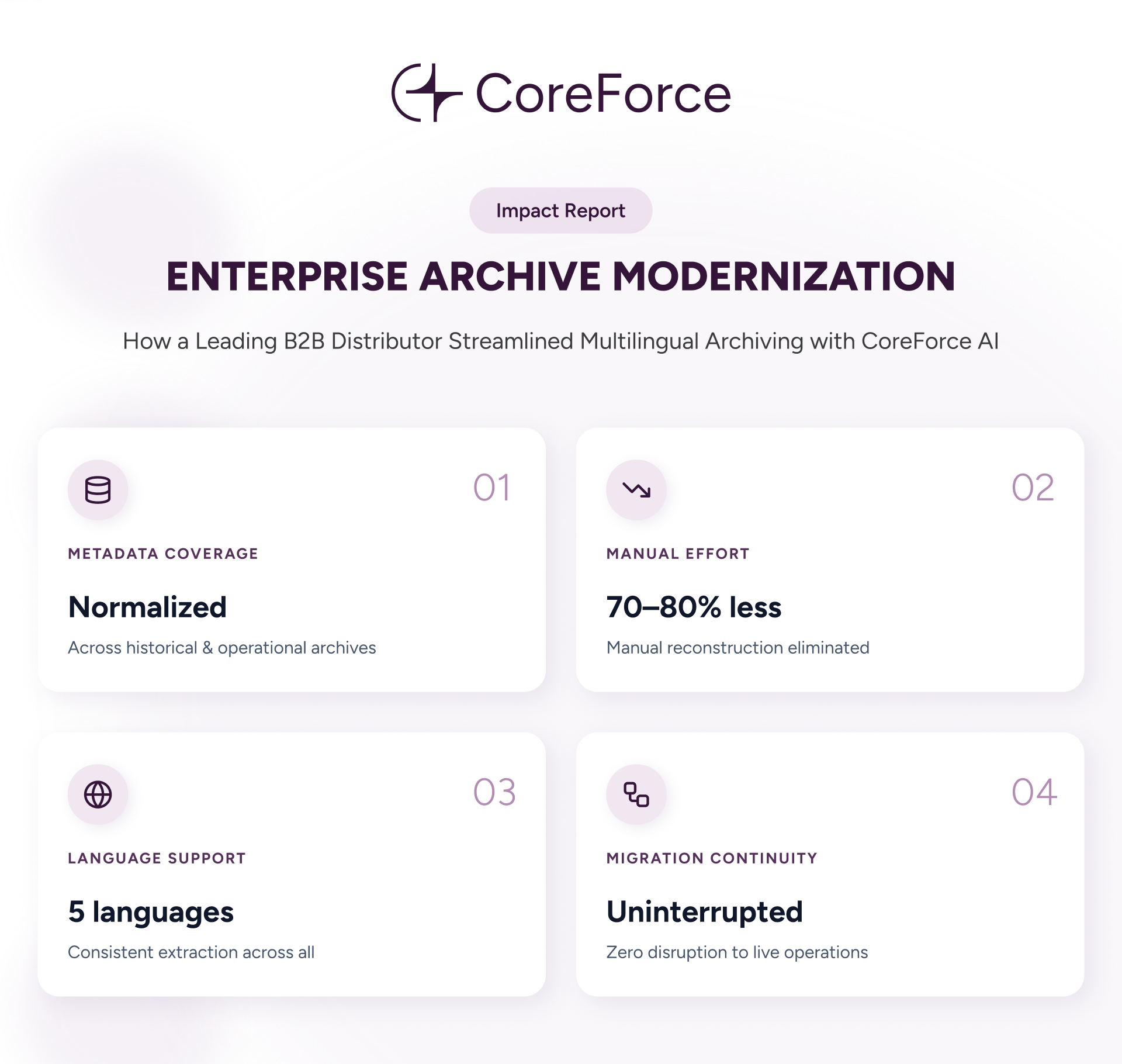
- Uninterrupted Operational Continuity: Archive accessibility was maintained without disruption throughout the migration and validation phases - a critical requirement for compliance and daily operational workflows.
- Future-Ready Document Infrastructure: The normalized metadata architecture created a scalable, integration-ready foundation supporting future ERP upgrades, compliance initiatives, and enterprise modernization programs.
Why CoreForce
The organization needed a document automation framework capable of operating effectively within a highly complex, multilingual archival environment - where neither template dependency nor manual intervention at scale were viable options.
CoreForce combined AI-powered extraction, adaptive processing logic, and validation-led workflows to deliver metadata consistency across five languages, multiple entity structures, and a live parallel migration environment.
Core platform capabilities applied:
- AI-Powered Extraction and Metadata Structuring
- Multilingual and Multi-Format Document Processing
- Multilingual and Multi-Format Document Processing
- Standardized XML Output Generation
- Standardized XML Output Generation
- Scalable Enterprise Document Intelligence Architecture
Conclusion
CoreForce AI enabled the business to modernize its enterprise archive infrastructure - transforming unstructured, inaccessible documents into structured operational intelligence while preserving full continuity during the migration process.
The result was a future-ready enterprise document environment: structured, searchable, compliant, and built to scale.
Modernizing an Enterprise Archive? Let's Talk.
If legacy archive environments are limiting operational accessibility, compliance readiness, or scalability - CoreForce AI can help you move forward without disruption. Let's connect at info@coreforce.ai.
