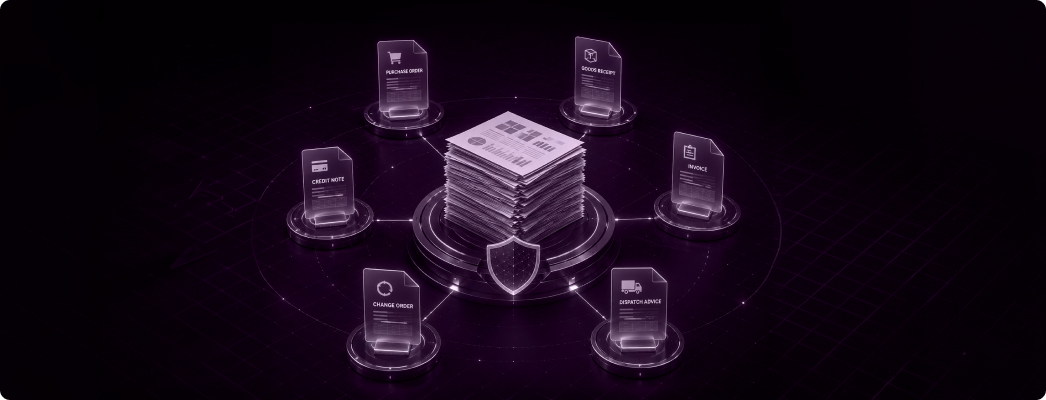
Ask most procurement or finance leaders whether their P2P process is automated, and the answer is usually yes, with a dashboard to prove it: touchless invoice rates up, exception volume down, cost per invoice trending in the right direction. Ask a harder question, how many of the documents that actually make up a purchase-to-payment cycle are touched by that same automation, and the answer gets noticeably less confident.
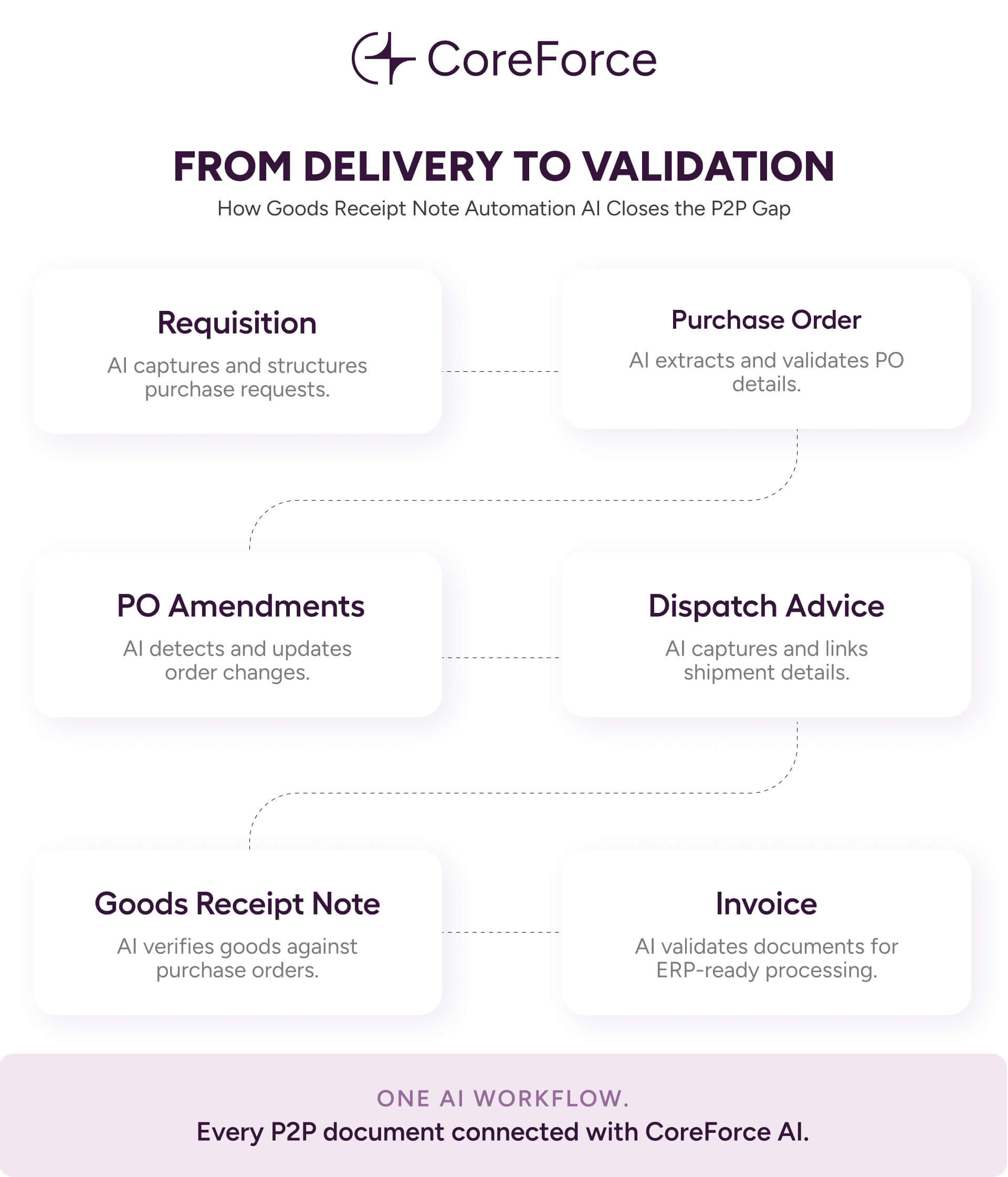
P2P automation, properly defined, is the use of AI-driven document processing to capture, validate, and reconcile every document type across the procure-to-pay cycle, from requisition through purchase order, goods receipt, dispatch advice, and invoice, rather than any single document processed in isolation. Most automation programs, whatever they are called internally, cover one part of that chain well and leave the rest running on email, spreadsheets, and institutional memory.
The Problem: What "P2P Automation" Actually Covers Today
Why invoice-first automation became the default entry point
Invoices were the logical place to start automating. They are high volume, arrive in reasonably predictable formats, and sit at the exact point where a payment gets released, which makes the return on automating them easy to justify to a CFO. None of that is wrong. The issue is what happened next in most organizations: invoice automation was treated as the finish line rather than the first step, and budget, attention, and tooling decisions followed that assumption for years afterward.
The unspoken assumption: one document type equals full coverage
Internally, a lot of organizations describe themselves as having "automated P2P" once invoice processing is in place, even though a purchase order, a goods receipt note, and a dispatch advice all still move through the same cycle largely untouched. This is not a deliberate decision so much as a quiet assumption that gets carried forward from one budget cycle to the next, because nothing forces anyone to test it until an audit, a supplier dispute, or a close-cycle delay exposes the gap.
The metric mismatch: touchless rate versus process completeness
Touchless invoice rate is one of the most commonly reported P2P metrics, and it is also one of the most misleading, because it only measures what happens to a document once it has already reached AP. It says nothing about how long the same transaction spent stuck earlier in the cycle, waiting on a manually keyed purchase order or an unreconciled goods receipt. A high touchless rate and a slow, error-prone P2P cycle are not mutually exclusive; they are, in fact, a fairly common combination.
How this gap shows up in practice, not just on paper
On an org chart or a vendor slide, P2P automation looks complete. In practice, it shows up as a procurement analyst manually re-keying a purchase order amendment into a spreadsheet, or a warehouse supervisor emailing a scanned goods receipt note to AP because there is no other way to get it into the system. These are not edge cases; for most organizations, they are the default way a meaningful share of transactions actually move through the cycle.
Mapping the Moving Parts: Every Document in the P2P Chain
A purchase-to-payment cycle is rarely a single handoff from order to payment. In most mid-size and large organizations, it runs through five or six distinct document types, each created by a different team, in a different system, often in a different format.
Requisition to purchase order
The cycle begins before a supplier is even involved, with an internal requisition that has to be approved and converted into a purchase order. Errors introduced here, an incorrect cost center, a missing approval, a quantity typed incorrectly, propagate through every downstream document and are far cheaper to catch at this stage than at invoice matching, three or four steps later.
Purchase order amendments and revisions
Purchase orders are rarely static. Prices get renegotiated, quantities get revised, delivery dates shift, and each of these changes generates a new version of the PO that downstream matching has to reconcile against. An automation program that only captures the original PO, and not its amendments, is validating against data that may already be out of date by the time a delivery arrives.
Goods receipt notes and partial deliveries
A goods receipt note confirms what actually arrived, and it is frequently generated by a warehouse or logistics team using a different system, or no system at all, than the one procurement or finance uses. Partial and split deliveries multiply this document type further: a single PO can generate several GRNs over the course of weeks, each of which has to be tracked and reconciled individually.
Dispatch advices and delivery confirmations
Between a supplier shipping goods and a warehouse logging their receipt, a dispatch advice or delivery confirmation often exists as a separate document, particularly in cross-border or multi-tier supply chains. These documents rarely arrive in a standard formats, and are among the least likely to be captured by automation focused primarily on financial documents.
Debit notes, credit notes, and returns
Returns, short shipments, and pricing corrections generate their own paper trail of debit and credit notes, each of which has to be matched back to the original PO, GRN, and invoice it corrects. Left manual, this is one of the more error-prone corners of the P2P cycle, since it requires tracing a correction back through three or four already-processed documents rather than validating a single new one.
Contract and pricing reference documents
Every match, whether it is a PO against a GRN or an invoice against a contract, ultimately depends on a pricing agreement or master service contract that lives as its own document, frequently outside the systems used for day-to-day transaction processing. When contract terms are not captured in a structured, machine-readable way, every downstream validation step is effectively guessing at the correct reference price rather than checking against it directly.
Why These Moving Parts Get Left Out
Point-tool architecture limits scope by design
Many invoice automation tools, including some of the market's most established platforms, were architected specifically around invoice capture and matching as the core use case. Extending that same tool to purchase orders, goods receipts, or dispatch advices is often not a configuration change; it requires a separate module, a separate implementation project, or simply falls outside what the tool was ever built to do.
Format diversity across suppliers and geographies
A purchase order from one supplier may be a structured EDI file; from another, an HTML email; from a third, a scanned PDF with handwritten annotations. Goods receipt notes and dispatch advices show even wider format variation, since they are frequently generated by logistics and warehouse systems that were never designed with downstream automation in mind. This diversity is precisely why these document types get quietly excluded from automation scope: they are harder to standardize than invoices, not less important.
Ownership is split across procurement, warehouse, and finance
Invoices sit squarely inside finance and AP, which gives invoice automation a single, clear owner. Purchase orders, goods receipts, and dispatch advices sit across procurement, warehouse or logistics, and finance simultaneously, and a document type without a single accountable owner is far less likely to end up on anyone's automation roadmap, even when everyone agrees it should be.
Vendor roadmaps follow the clearest ROI, not the widest coverage
Software vendors prioritize the features that are easiest to sell, and invoice automation has the most straightforward, easiest-to-quantify return of any document type in the P2P cycle. Purchase order and goods receipt automation have a real but harder-to-isolate return, since their value shows up as avoided delays and avoided errors rather than a direct cost-per-document reduction, which pushes them lower on most vendor roadmaps regardless of how much operational pain they cause internally
Change management resistance across multiple teams
Automating a single, finance-owned document type requires convincing one team to change how it works. Automating purchase orders and goods receipts requires coordinated change management across procurement, warehouse operations, and finance simultaneously, each with its own priorities, systems, and appetite for a new process. That coordination cost alone is often enough to keep a coverage-gap initiative permanently at the bottom of a roadmap, even when the business case is sound.
What Happens When the Moving Parts Aren't Automated
Hidden manual work that never shows up on an AP dashboard
A touchless invoice rate can look excellent while a team elsewhere is still manually keying purchase orders or matching goods receipts against paper delivery notes. Because that manual work sits outside the metric being measured, it stays invisible to leadership until it surfaces as a delay, a discrepancy, or a resourcing request that seems to come out of nowhere.
Audit and compliance exposure
An unbroken, timestamped record from requisition through payment is what auditors actually want to see. A process where invoices are digitized but purchase orders and goods receipts are reconstructed from email threads during audit season creates exactly the kind of documentation gap that turns a routine review into an extended one.
Working capital and supplier relationship costs
Unreconciled purchase order amendments and goods receipt discrepancies are a common, quiet source of payment delays, and payment delays are a common, quiet source of strained supplier relationships and lost early payment discounts. None of this shows up as a single dramatic failure; it accumulates as a steady drag on both cash efficiency and supplier goodwill.
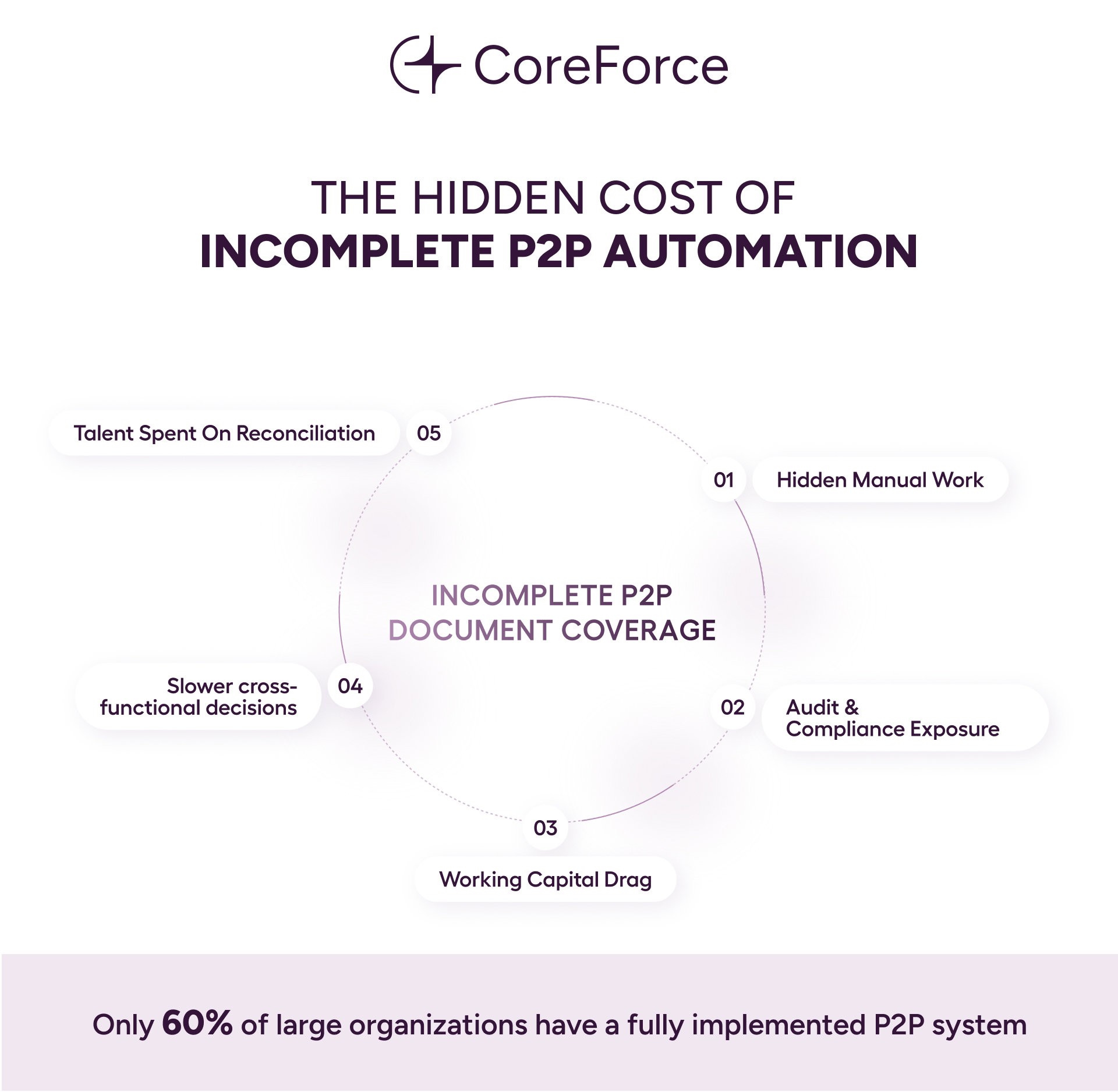
Slower cross-functional decision-making
When purchase order, goods receipt, and dispatch data live in disconnected spreadsheets and inboxes rather than a shared, structured system, procurement and finance leaders are making decisions on a lag. A question as simple as "how much of this quarter's committed spend has actually been delivered" can take days to answer manually, which is far too slow for decisions that increasingly need to happen in near real time.
Talent spent on reconciliation instead of analysis
Skilled procurement and AP analysts spend a disproportionate share of their time manually reconciling documents that automation should be handling, rather than on supplier negotiation, spend analysis, or process improvement. This is as much a talent cost as a process cost: the people capable of doing higher-value work are the ones stuck doing the manual matching, because the moving parts were never automated in the first place. McKinsey's research on procurement functions found that even as gen AI and automation adoption accelerates, only 60 percent of large organizations and 30 percent of small organizations have a fully implemented procure-to-pay system in place, meaning a substantial share of the P2P cycle still runs on manual handling in the majority of organizations, regardless of company size.
Source: McKinsey, Transforming procurement functions for an AI-driven world
What a Fully Covered P2P Automation Model Looks Like
Capture across every document type, not just invoices
A fully covered model treats requisitions, purchase orders and their amendments, goods receipt notes, dispatch advices, debit and credit notes, and invoices as one connected intake process, regardless of format or originating system. Whether a document arrives as a structured file, a PDF, a scanned image, or an HTML email, it is captured and structured the same way, so no document type is excluded simply because it is harder to standardize.
Cross-document validation instead of siloed checks
Rather than validating each document independently, a connected model checks documents against each other as they arrive: a goods receipt against its purchase order, a dispatch advice against the shipment it corresponds to, an invoice against both. Discrepancies surface at the point they occur, not weeks later during a batch review or month-end close.
A single, ERP-agnostic source of truth
CoreForce's platform is built specifically around this model: an ERP-agnostic, AI-powered document processing layer that captures and reconciles requisitions, purchase orders, goods receipts, dispatch advices, and invoices across the P2P and O2C lifecycle, so automation coverage matches the actual shape of the process rather than the shape of the first tool an organization happened to buy.
Configurable ownership without losing a single view
A connected model does not force procurement, warehouse, and finance to give up ownership of the documents they are closest to; it lets each team continue working the way it does today while feeding into one shared, validated data layer. Procurement can still manage purchase orders, warehouse can still log receipts, and finance still owns invoicing, but all three now validate against a common source of truth instead of three disconnected ones
Built to absorb new document types as the process evolves
P2P processes are not static: new supplier onboarding formats, new regulatory requirements, or new logistics partners routinely introduce document variations that did not exist a year earlier. A connected model built for extensibility can absorb these changes as configuration rather than a new implementation project, which matters more over a multi-year horizon than initial coverage alone.
- Capture: ingest every document type from email, API, SFTP, or manual upload, regardless of format (PDF, TIFF, JPG, PNG, DOCX, HTML, EDI)
- Extract: read structured and unstructured data across requisitions, POs, amendments, GRNs, dispatch advices, and Invoices
- Validate: cross-check documents against each other and against ERP data in real time, flagging mismatches at the point they occur
- Export: push validated data into the ERP in the required format, with a complete, timestamped audit trail across the full cycle
The Outlook: Why Coverage, Not Just Speed, Is the Next Automation Milestone
The efficiency curve on invoice-only automation is flattening
Most procurement and finance functions have already captured the easy wins available from invoice-only automation; the efficiency curve on that single document type is flattening for organizations that started early. Squeezing another few percentage points out of an already-optimized touchless invoice rate delivers diminishing returns compared with extending the same discipline to document types that are still almost entirely manual.
The next material gain is coverage, not speed
The next material gain is not a faster invoice, it is a fully covered P2P cycle where every document type is captured, validated, and reconciled with the same discipline currently reserved for invoices alone. Organizations that make this shift first are effectively picking up value that invoice-only competitors have already left on the table for years
This reframes automation as a cross-functional investment, not a finance-only one
For Procurement Heads and P2P Managers, this reframes the automation conversation from a finance-owned initiative into a cross-functional one, since purchase orders, goods receipts, and dispatch advices touch procurement and warehouse operations directly. Framing the next automation investment around full P2P coverage, rather than a specific document type, is also a more accurate reflection of what the process actually is, and tends to secure buy-in more easily precisely because every affected team can see its own document type represented in the plan.
Frequently Asked Questions
What is P2P automation, exactly?
P2P automation is the use of AI-driven document processing to capture, validate, and reconcile every document across the procure-to-pay cycle, including requisitions, purchase orders, goods receipts, dispatch advices, and invoices, rather than automating a single document type in isolation.
Is invoice automation the same as P2P automation?
No. Invoice automation covers the final document in the procure-to-pay chain, while full P2P automation extends coverage to purchase orders, their amendments, goods receipts, and dispatch advices as well.
Why do purchase orders and goods receipts often stay manual even after invoice automation is in place?
These document types are typically owned by different teams than AP, arrive in more varied formats, and were often outside the scope of the tools originally purchased to automate invoices, which leaves them unautomated by default rather than by deliberate decision.
How does incomplete P2P coverage affect audit readiness?
An audit trail that is complete for invoices but reconstructed manually for purchase orders and goods receipts creates documentation gaps that typically extend the length and difficulty of an audit review.
Does closing this coverage gap require replacing existing invoice automation or ERP systems?
No. An ERP-agnostic document processing layer can extend coverage to purchase orders, goods receipts, and dispatch advices alongside existing invoice automation and ERP systems, without requiring a system replacement.
Conclusion
A P2P process is only as automated as its least-covered document type, and for most organizations, that is not the invoice. Purchase orders, goods receipts, dispatch advices, and the corrections that follow them are still moving through email and spreadsheets in the same organizations that consider their P2P automation program complete. Closing that gap is less about adding a new tool and more about extending the same discipline already applied to invoices across the rest of the chain.
CoreForce was built to close exactly this gap, capturing and reconciling every document across the P2P and O2C lifecycle so automation coverage matches the actual shape of the process.
Schedule your demo today at info@coreforce.ai
