
What is compliance document automation?
It is the use of AI-driven systems to capture, validate, route, and retain business documents, invoices, purchase orders, contracts, and employee records, in a way that produces a complete, traceable, and defensible record for auditors and regulators. Done well, it turns document handling from an operational afterthought into a control point. Done poorly, it creates a false sense of coverage while gaps quietly accumulate underneath.
No compliance checklist means risk teams inherit the problem later. That is the pattern behind this piece: a vendor is selected primarily for speed or cost, a checklist for audit trail completeness, duplicate detection, and role-based access never gets built, and eighteen months later the risk and compliance function is the one explaining a gap to an external auditor or a regulator that the AP or procurement team created and never flagged.
When "Automated" Quietly Stops Meaning "Compliant"
Most automation deployments are scoped by the function that owns the pain: accounts payable wants fewer manual touches, procurement wants faster PO matching. Compliance requirements get folded in as an assumption rather than a specification. The result is a system that processes documents quickly but was never actually validated against GST, VAT, HST, or SOX and GDPR-style data governance requirements.
This is the quiet failure mode of compliance document automation done wrong: nothing breaks visibly. Invoices still get paid. Purchase orders still get matched. The dashboards report clean throughput. The gap only becomes visible when someone asks a question the system was never built to answer, such as "show me every version of this contract and who touched it," or "prove this vendor's tax treatment was validated at the point of entry," or "why does this duplicate payment not appear in your exception log."
Risk and compliance managers are usually not in the room when the automation vendor is selected. They inherit the platform after it is already live, embedded in daily operations, and difficult to unwind. By the time a gap surfaces, in an internal audit finding, a regulatory inquiry, or a forensic review after a duplicate payment incident, the question is no longer "should we have built a compliance checklist" but "how much exposure did we already accumulate."
The Scale of the Exposure
The scale of this problem is larger than most organizations assume. According to Ardent Partners' AP research, a substantial share of accounts payable teams still operate with incomplete or manual controls layered awkwardly onto partially automated systems, and IOFM benchmarking has repeatedly flagged audit-trail completeness and duplicate detection as among the most commonly cited AP compliance gaps in enterprise environments (source: IOFM AP compliance research). These are not edge cases. They are structural.
Consider the mechanics of what a genuinely compliant document automation environment has to do continuously, not just at go-live:
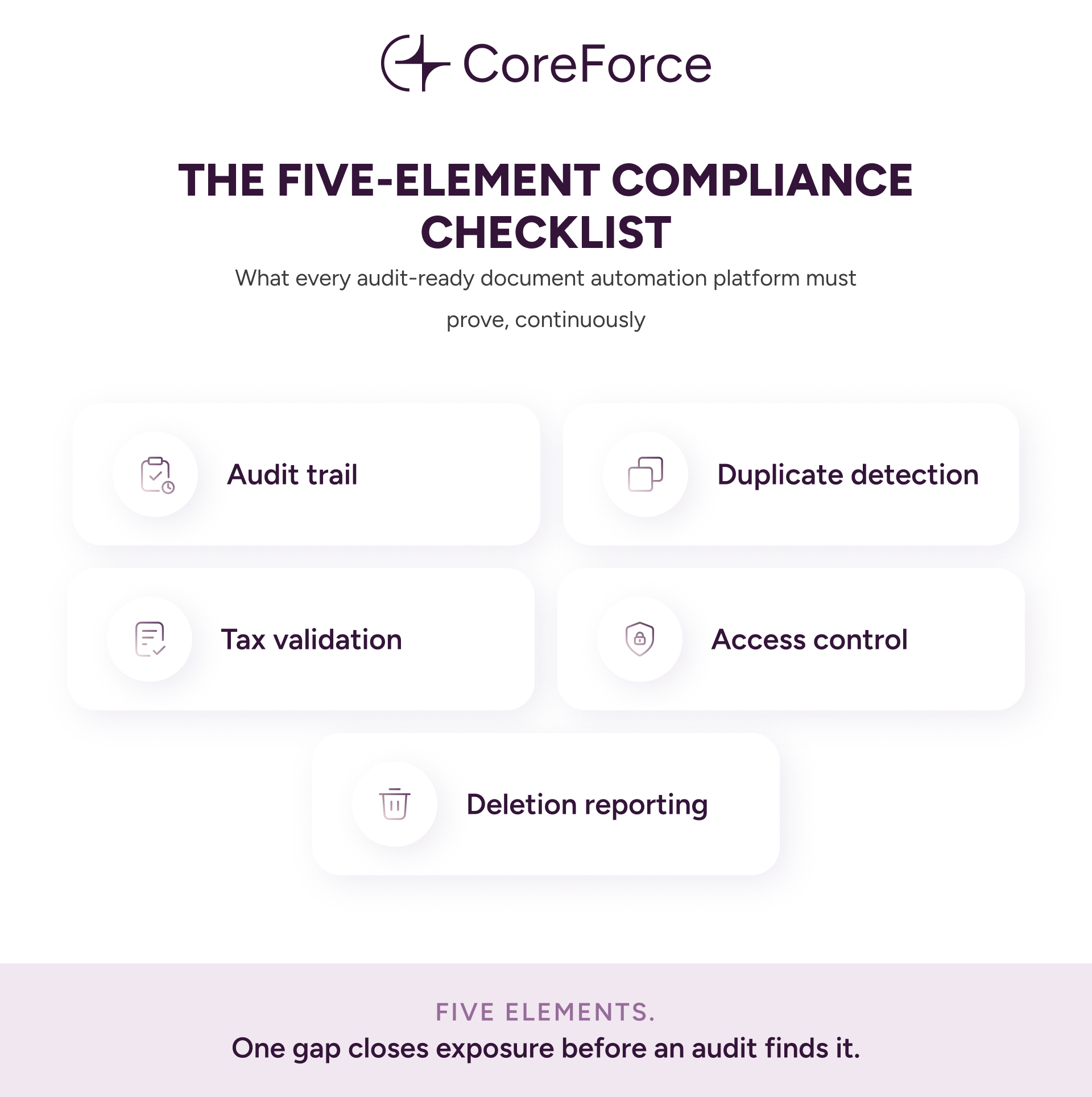
- Audit trail: Maintain a complete, timestamped audit trail for every document from ingestion through final disposition, not a summary log that starts after validation.
- Duplicate detection: Detect duplicates by content, metadata, and unique identifier, not just by invoice number, which is trivially easy to alter or misrepresent.
- Tax validation: Apply region-specific tax and regulatory logic (GST, VAT, HST, and jurisdictional variants) automatically, rather than relying on a manual review step that gets skipped under volume pressure.
- Acess control: Enforce role-based access control so that who touched a document, and when, is itself part of the audit record.
- Deletion reporting: Produce a deletion and governance report, because what a system did not retain is as material to an auditor as what it did.
When even one of these five elements is missing, the organization does not have a compliance gap in the abstract. It has a specific, discoverable, and often reportable exposure the moment a regulator, external auditor, or litigation discovery request asks the right question.
Why the Gap Persists Even After Everyone Knows About It
The uncomfortable part of this story is that most compliance and risk teams are not unaware of the problem. Awareness is high. Remediation is where things stall, for four recurring reasons.
First, automation vendors are frequently evaluated and purchased by finance or procurement, who prioritize processing speed, cost per document, and straight-through processing rate. Audit trail completeness, duplicate detection sophistication, and access governance are rarely line items in that evaluation, because the buyer is not the one who will answer for them later.
Second, retrofitting compliance controls onto a live automation system is expensive and operationally disruptive in ways that a green-field requirement never is. The apparent cost of pausing operations to rebuild a control layer is always visible and immediate. The cost of not doing so is deferred, diffuse, and easy to underweight until it lands on someone's desk as a finding with a remediation deadline attached.
Third, automation vendor failed compliance conversations tend to surface only reactively. A regulatory audit request, an internal control review, or a duplicate payment discovered during month-end close becomes the trigger. Most platforms are never stress-tested against an auditor's actual questions until an auditor is the one asking them.
Fourth, "automated" and "compliant" get conflated in vendor marketing and internal reporting alike. Processing speed and compliance readiness are separate properties of a system, and a platform can excel at one while failing the other entirely.
There is a structural incentive problem underneath all four of these reasons. The team that experiences the pain of a compliance gap, risk and compliance, is rarely the team that controls the automation budget or the vendor relationship. Until compliance requirements are written into the vendor evaluation scorecard alongside cost and speed, this pattern will keep repeating regardless of how sophisticated the underlying AI becomes.
What a Better Model Actually Looks Like
The organizations that avoid this trap treat compliance requirements as a design input to document automation, not a downstream audit finding to be managed after the fact.
A genuinely audit-ready model for compliance document automation combines AI-driven processing with a human-in-the-loop safety net, so that when confidence in an extracted field or a validation rule drops, the document does not simply pass through anyway. It escalates to a structured review queue, with the escalation itself becoming part of the traceable record.
Full document lifecycle traceability means every document carries a complete history from the moment it enters the system: how it arrived, what validation rules it passed or failed, who reviewed any exception, and what happened to it at final disposition. CoreForce's platform architecture is built around this principle: end-to-end visibility with full audit trails and real-time status tracking for every document, not a retrofit added after a finding.
Dynamic validation against vendor, customer, and item masters in real time, rather than batch reconciliation after the fact, closes another common gap. So does duplicate detection that checks content and metadata together. Role-based access control and secure single sign-on turn "who touched this document and when" into a queryable fact.
CoreForce AI approaches this as a cross-functional control layer rather than a finance point solution. Compliance with global tax standards, GST, VAT, HST, and region-specific rules, is built into the validation logic rather than bolted on as a manual checklist item. For risk and compliance managers evaluating whether an existing automation vendor actually closes these gaps, CoreForce's approach to audit and compliance readiness is worth a structured comparison against the five-element checklist above.
Practically, this changes what a risk and compliance manager should ask for during vendor evaluation. Instead of asking whether a platform is "compliant" in the abstract, the useful question is narrower: can this system produce, on request, a complete document lineage report for a document selected at random from six months ago, including every validation rule it passed, every exception it triggered, and every person who touched it.
Confidence scoring plays a specific role here. Field-level confidence scores determine which documents route to automatic processing and which route to human review, and that routing decision is itself an audit-relevant control. The routing logic is not incidental to compliance. It is part of the compliance architecture. This is also where the difference between a document processing tool and a document processing platform with expert-led managed services becomes material for compliance readiness specifically. CoreForce AI's model routes complex or non-standard documents to expert reviewers rather than letting confidence drop silently, so the completion guarantee and the audit trail hold even for the documents that do not fit the standard template.
What This Means Going Forward
Regulatory scrutiny of document handling is not decreasing. E-invoicing mandates are expanding across the EU, with France's rollout in 2024 and wider EU coverage anticipated by 2028, and GST-linked digital reporting requirements continuing to tighten across other markets.
The organizations best positioned for this shift are treating the compliance checklist not as a procurement afterthought but as the specification the automation platform is measured against from the outset: complete audit trails, real duplicate detection, enforced access governance, region-aware tax validation, and defensible retention reporting.
There is also a practical sequencing question worth answering now rather than during the next audit cycle. Organizations do not need to replace an entire automation stack overnight to close this gap. The five-element checklist can be used as a scoring rubric against the current vendor first.
The broader lesson for any risk and compliance function evaluating document automation, current or prospective, is that speed and control are not competing priorities to be traded off. Compliance readiness is not the tax paid for automation. It is the feature that makes automation trustworthy enough to scale in the first place.
CoreForce AI was built on the premise that document automation and audit readiness are the same requirement, not two competing priorities to be traded off against each other. Book a personalised demo at coreforce.ai.A coreforce.ai
Frequently Asked Questions
What is compliance document automation?
Compliance document automation is the use of AI-driven systems to capture, validate, route, and retain business documents in a way that produces a complete, timestamped, and defensible audit record, not just faster processing.
How do I know if my current automation vendor has a compliance gap?
Test it against five elements: a complete audit trail from ingestion to disposition, duplicate detection by content and metadata, real-time validation against region-specific tax rules, role-based access control, and a deletion or governance report.
Why do compliance gaps in automated systems go unnoticed for so long?
Because processing speed and compliance readiness are separate properties. Dashboards showing high throughput do not test whether the underlying audit trail would survive a formal regulatory review.
What should risk and compliance teams do if they inherited a non-compliant automation platform?
Start with the five-element checklist rather than a full platform replacement decision. Document exactly which elements are missing and quantify the exposure.
