
In most enterprises, capital doesn’t get trapped in bank accounts - it gets trapped in processes. Slow approvals, manual reconciliations, and fragmented workflows quietly introduce friction that restricts liquidity and weakens operational agility. While organizations often focus on revenue growth or cost control, they frequently underestimate how much working capital is constrained by inefficient business document handling.
As finance leaders look for sustainable ways to improve cash flow and operational resilience, attention is increasingly shifting toward how business documents are captured, validated, approved, and integrated across systems. Transforming these workflows - from invoices and purchase orders to receipt validations - plays a direct role in improving cash predictability, strengthening forecasting, and supporting scalable growth.
Why Manual Business Document Handling Creates Strategic Blind Spots
Even in well-run enterprises, business documents routinely sit idle - waiting in inboxes, buried in email threads, or stalled in multi-level approval queues. Teams spend significant time reconciling mismatched data, rechecking repetitive fields, and resolving inconsistencies across disconnected systems.
These delays compound quietly. Payments slow. Cash visibility weakens. Early-payment opportunities are missed. Over time, this creates blind spots that limit leadership’s ability to accurately assess liabilities, anticipate cash needs, and make timely decisions. Manual document handling doesn’t just slow operations - it reduces the speed and confidence of enterprise decision-making.
Automation Resets the Rhythm of Capital Movement
AI-led automation fundamentally changes how quickly, and consistently business documents move through the enterprise. Instead of waiting for manual intake, classification, and validation, automated systems process documents the moment they arrive. Data accuracy improves. Exceptions are identified earlier. Approvals are routed intelligently based on predefined logic rather than manual follow-ups or static email chains.
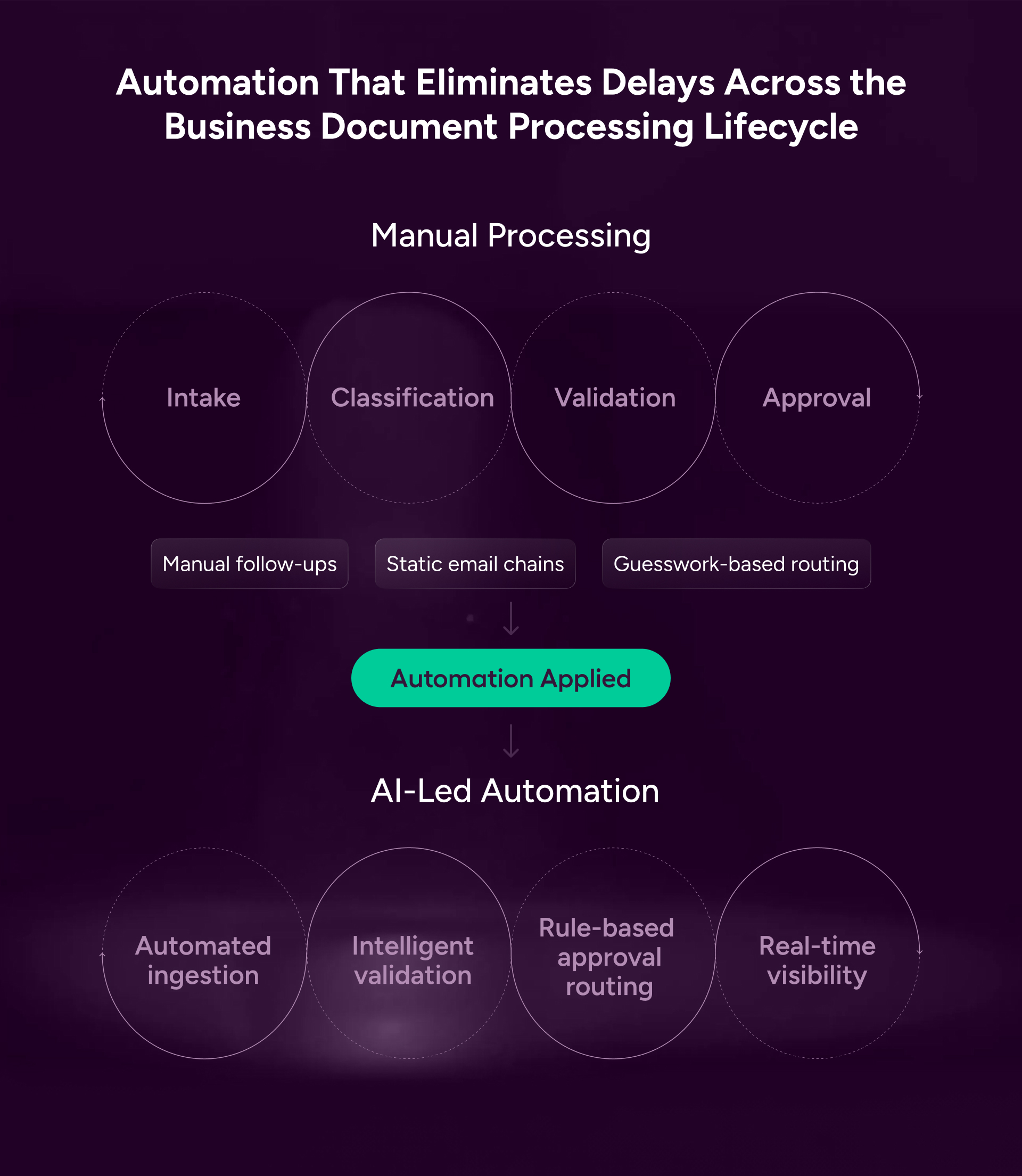
As document processing becomes more predictable and less error-prone, capital begins to move with greater consistency. Cash flow timing improves not because payments are forced faster, but because upstream friction is removed. Finance teams regain control over cadence, visibility, and execution without increasing operational strain. Guidance from IBM
Real-Time Visibility Strengthens Cash Planning and Scenario Modelling
Traditional AP environments often distribute information across multiple tools, spreadsheets, and email threads. This fragmentation makes it difficult to understand what is pending, what is blocked, and what is likely to impact cash position in the near term.
Automated business document ecosystems consolidate these signals into a single, continuously updated view. Leaders gain real-time insight into document status, liabilities, and approval bottlenecks, enabling more accurate forecasting and dynamic scenario planning. Decisions around cash allocation, vendor prioritization, and risk management become proactive rather than reactive. Financial overview from Corporate Finance Institute
Scaling Without Scaling Cost: The New AP Operating Model
As organizations grow, document volumes increase sharply. Manual workflows struggle to keep pace, leading to backlogs, longer approval cycles, and rising operational costs. Automation breaks this pattern.
High-volume periods no longer require proportional increases in headcount. Routine validations, controls, and audit trails operate continuously in the background, while human attention is reserved for true exceptions. This allows finance operations to scale transaction volumes without sacrificing control, compliance, or efficiency. Enterprise technology insights from TechTarget
When AP Becomes a Strategic Lever - Not an Administrative Burden
When business document processing is automated end to end, accounts payable evolves beyond a back-office function. Approval cycles accelerate. Working capital becomes more accessible. Forecasting improves. Financial visibility expands across the enterprise.
Rather than reacting to issues after they occur, finance teams gain the ability to anticipate risk, model outcomes, and support strategic planning with greater confidence. Business document automation turns AP into a data-rich, forward-looking capability that strengthens enterprise resilience and agility.
Explore How CoreForce Helps Turn AP Into a Capital Engine
CoreForce combines AI-powered ingestion, intelligent workflows, real-time visibility, and automated governance to help enterprises move capital faster, scale operations efficiently, and strengthen financial predictability. By eliminating document friction at scale, CoreForce enables finance teams to shift from manual execution to strategic control.
Explore how CoreForce transforms business document operations into a capital advantage - schedule your demo today at info@coreforce.ai
