
Introduction: Why Invoice Reconciliation Is Now a Cash Flow Priority
How much working capital is locked inside unresolved invoices at any given moment?
Delayed invoice reconciliation remains one of the most persistent and underestimated barriers to faster payment realization and consistent financial performance. As invoice volumes rise and document complexity increases, traditional reconciliation methods struggle to keep pace. The outcome is familiar - approval delays, growing exception queues, and cash trapped in operational bottlenecks.
A IBM research highlights that finance teams adopting automation and AI can accelerate processing cycles while improving control and visibility.
This article explains how automated invoice reconciliation addresses these challenges. It outlines the limitations of manual reconciliation, demonstrates how automation removes friction from invoice workflows, and shows how intelligent document processing enables sustainable cash flow optimization.
The Hidden Cost of Manual Invoice Reconciliation
Manual invoice reconciliation often appears manageable on the surface, but inefficiencies become increasingly visible as operations scale. Inconsistent invoice formats, disconnected systems, and frequent data mismatches introduce delays that compound over time.
These inefficiencies do not just slow operations; they directly impact liquidity and forecasting accuracy. When reconciliation cycles stretch, payment execution becomes reactive rather than planned, limiting financial agility.
Why Automated Invoice Reconciliation Changes the Equation
Automated invoice reconciliation replaces manual checks with AI-driven data extraction, intelligent matching, and configurable validation logic. Invoices are reconciled against source documents in real time, ensuring speed, accuracy, and consistency at scale.
PwC’s enterprise finance modernization initiatives emphasize intelligent automation as a strategic lever for improving operational efficiency, governance, and cash flow performance.
Instead of reacting to discrepancies after delays occur, automation identifies issues early and routes them through structured workflows. High-confidence invoices move forward automatically, while exceptions are resolved efficiently without restarting the process.
How Automated Invoice Reconciliation Enables Faster Payment Realization
1. Real-Time Matching Reduces Processing Delays
Automated reconciliation performs instant two-way and three-way matching by validating invoice data against purchase orders and goods receipts. Discrepancies are detected immediately, preventing invoices from being delayed in manual review cycles.
This acceleration directly supports faster payment realization, enabling invoices to progress smoothly from receipt to approval.
2. Structured Exception Handling Keeps Invoices Moving
Instead of rejecting invoices outright, intelligent workflows classify exceptions and route them through predefined resolution paths. Minor discrepancies can be addressed without restarting the entire process, preserving processing effort and avoiding unnecessary delays.
This structured approach improves consistency while significantly reducing operational friction across invoice workflows.
3. Straight-Through Processing Improves Throughput
Invoices that meet predefined accuracy and validation thresholds are automatically approved and posted. Straight-through processing minimizes human intervention, shortens cycle times, and increases overall throughput without compromising financial controls.
4. Automated Validation Strengthens Control Without Slowing Payments
Automated invoice reconciliation applies predefined business rules, tax logic, and compliance checks consistently across all invoices. Validation occurs in parallel with processing rather than as a separate manual step.
By embedding control directly into the workflow, organizations maintain accuracy and audit readiness while still accelerating payment cycles.
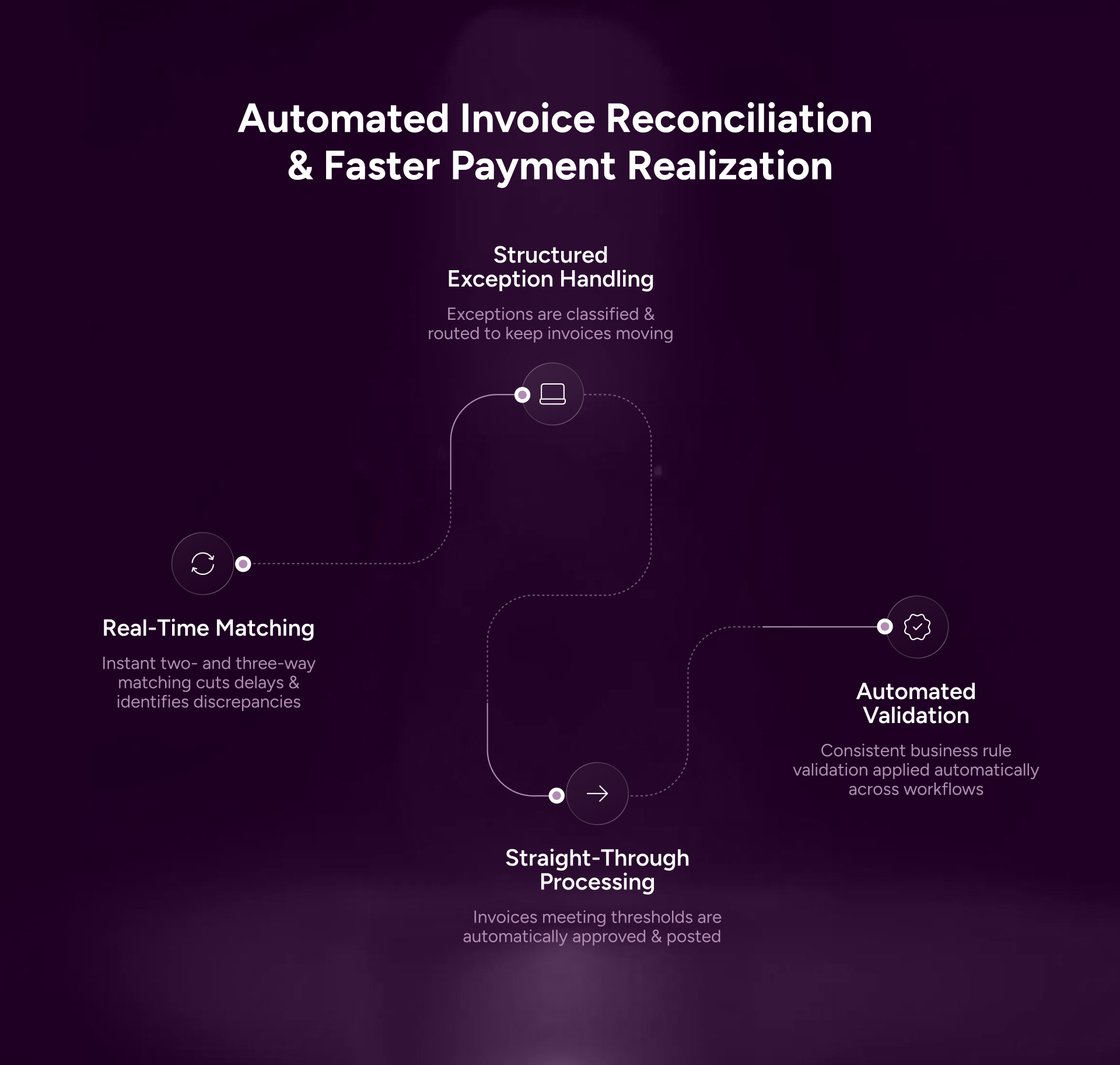
Automated invoice reconciliation ensuring cash flow validation and faster payments
The Role of Automated Invoice Reconciliation in Cash Flow Optimization
Effective cash flow optimization depends on visibility, accuracy, and timing. When reconciliation processes are slow or inconsistent, payment planning becomes reactive rather than strategic.
Automation improves visibility into liabilities and payment schedules, helping organizations align payment execution with broader working capital strategies and liquidity goals.
Conclusion: Turning Invoice Reconciliation into a Strategic Advantage
Invoice reconciliation no longer needs to be a bottleneck that slows payments and restricts liquidity. With automated invoice reconciliation, organizations can achieve faster payment realization, reduce operational inefficiencies, and drive sustainable cash flow optimization.
By embedding intelligence into document workflows, reconciliation becomes a strategic enabler of financial agility, compliance confidence, and operational scalability.
CoreForce supports this transformation by automating invoice ingestion, AI-led reconciliation, exception handling, and ERP integration within a unified document automation platform. Through intelligent processing and scalable workflows, CoreForce helps organizations move from bottlenecks to breakthroughs, turning invoice reconciliation into a driver of measurable financial performance.
To learn more about how CoreForce enables automated invoice reconciliation and intelligent document processing, visit info@coreforce.ai.
