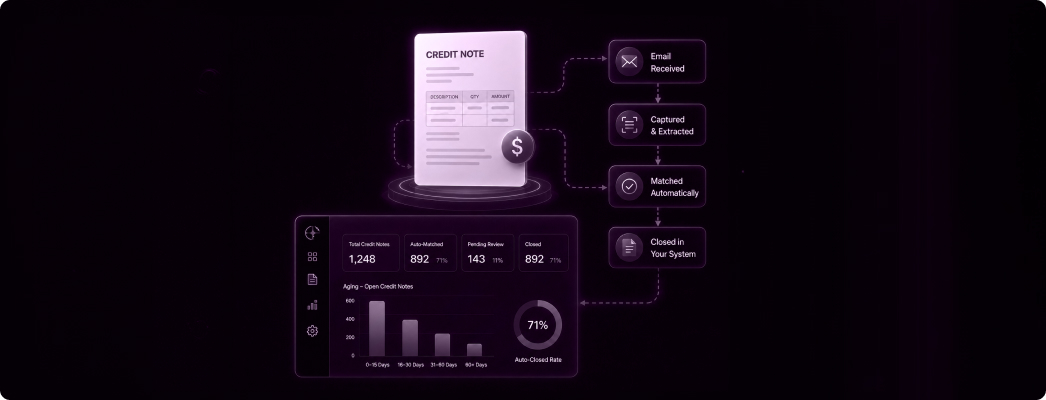
Every AR team knows the pattern. A credit note arrives, the figures look reasonable, but by the time someone has matched it to the original invoice, verified the adjustment reason, confirmed the vendor entry, and pushed the update to the ERP, days have passed, and the reconciliation queue has grown. Credit note automation AI is changing how that sequence works, and AR managers running high-volume, multi-vendor environments are already seeing the difference. Credit note automation AI refers to the application of intelligent document processing and machine learning to capture, classify, validate, and post credit notes and financial adjustments without manual re-entry. Where traditional workflows depend on people to catch discrepancies and chase confirmations, AI-powered systems handle matching, exception routing, and ERP integration in a structured, auditable process. For AR managers, the stakes are real. Unresolved credit notes distort account balances, inflate Days Sales Outstanding (DSO), and create audit exposure. The question at the consideration stage is not whether automation helps, it is which approach actually handles the complexity your documents bring.
Why Manual Credit Note Processing Keeps Breaking Down
Credit notes look simple on paper. In practice, they arrive in inconsistent formats, reference order numbers from different systems, carry varying tax treatments depending on the supplier's region, and sometimes relate to transactions that span multiple billing periods.
The Format Problem
A single AR team managing 50 or more active vendor accounts will typically handle credit notes in PDF, email body text, scanned images, and occasionally structured EDI or XML feeds. Each format demands a different extraction approach. Manual teams build workarounds, spreadsheets, email flags, and reference tables, but as volume grows, those workarounds become the bottleneck.
The Matching Problem
Matching a credit note to the correct original invoice sounds straightforward until the credit references a partial order, uses a different line-item numbering convention, or comes from a vendor who recently updated their document template. Exception rates climb. Processing time stretches. And the cost of each unresolved credit compounds until someone chases it down.
The Reconciliation Lag
According to IOFM research on AR automation, finance teams that rely on manual reconciliation processes typically carry a reconciliation backlog of several working days, with exception-heavy periods pushing that further. That lag translates directly into DSO, revenue leakage risk, and the kind of period-end pressure that AR managers spend significant time managing. Vendor credit note processing cannot afford to be the last item on the list.
What Credit Adjustment Automation Actually Changes
The shift from manual to AI-powered credit adjustment automation is not simply about removing data entry. It is about changing where human attention goes. Instead of spending time on routine capture and matching, AR teams move to exception review and process governance.
Structured Capture from Any Format
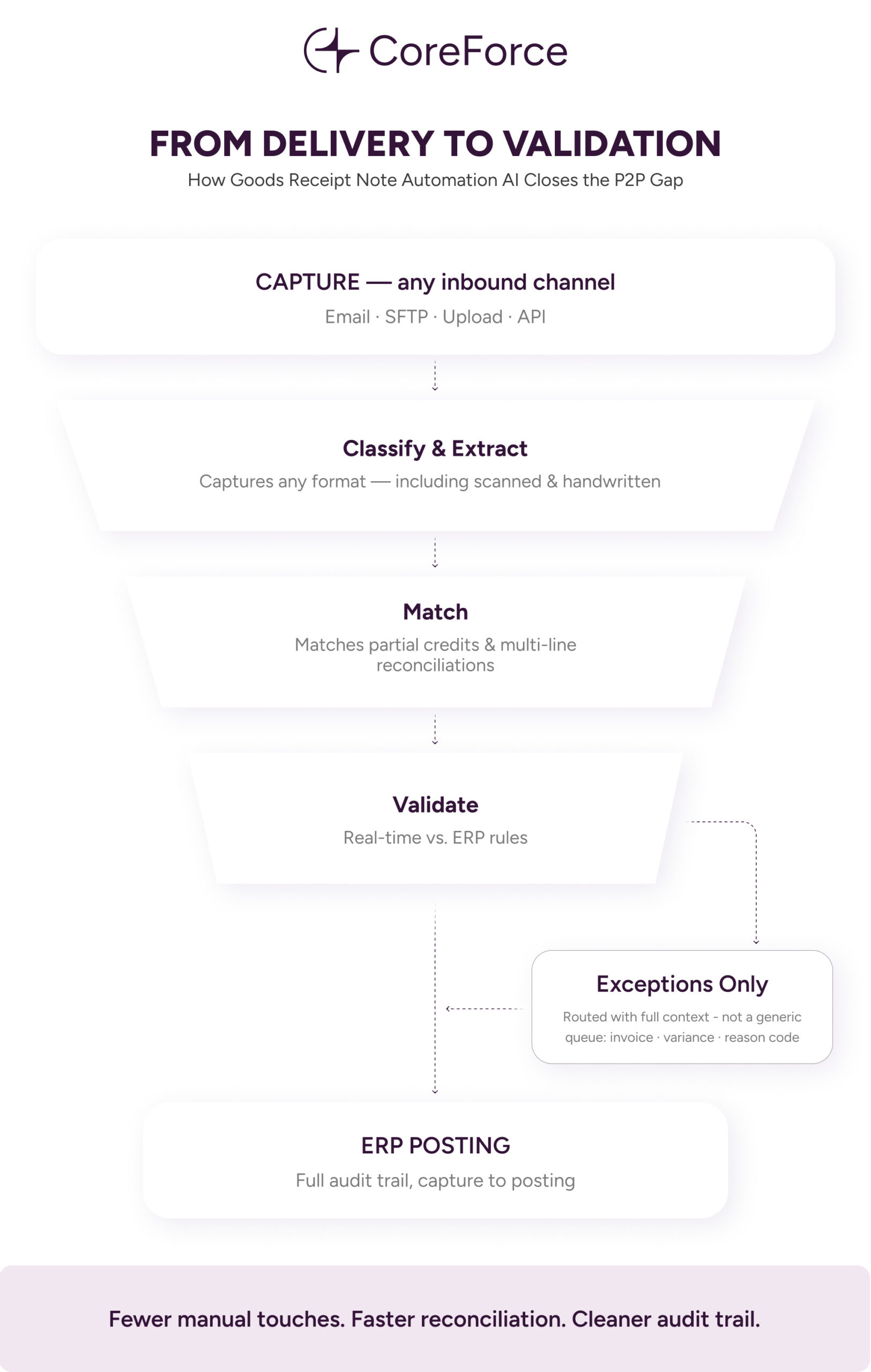
AI-powered ingestion handles credit notes arriving via email, SFTP, direct upload, or API. The document is classified on receipt, key fields are extracted regardless of template layout, and the record is enriched against vendor master data before any human reviews it. ICR (Intelligent Character Recognition) extends that capability to scanned and handwritten inputs, which matter more than most teams expect when dealing with older supplier relationships.
Matching That Reflects Real-World Complexity
Effective vendor credit note processing requires matching logic that can handle partial credits, multi-line reconciliations, price variance adjustments, and quantity corrections simultaneously. AI-based validation checks the extracted data against business rules and ERP master data in real time, flagging only the records that genuinely need human review rather than routing everything through an approval queue.
Exception Routing, Not Exception Bottlenecks
When a mismatch is detected, the document does not stall. It moves to a structured exception queue with the relevant context already surfaced: the original invoice, the variance, the reason code, and the vendor history. The AR team reviews and resolves, rather than investigates from scratch.
Evaluation Criteria: What to Look for in Credit Note Automation AI
When assessing solutions for AR automation, AR managers should evaluate against the specific complexities their teams face, not against a generic feature list.
Completion Guarantee
Most automation tools work well on clean, standard documents. The harder test is what happens when AI confidence drops: on a partially obscured credit note, a handwritten adjustment, or a document in a language outside the primary configured set. The right platform escalates to an expert review layer rather than failing silently. A 100% document completion guarantee backed by a human-in-the-loop model is the right benchmark, not a headline accuracy rate that disappears when the document is non-standard.
ERP Compatibility Without Rework
Credit adjustment automation should push validated, structured data directly into the existing ERP, whether SAP, Oracle, Microsoft Dynamics, or another system, without requiring system replacement or extended integration projects. ERP-agnostic architecture with open API connectivity means the investment delivers value within the existing stack.
Audit Trail and Compliance Readiness
Every credit note, adjustment, and reconciliation action needs a documented trail: who reviewed it, what was changed, and when the ERP received the update. For AR managers working under audit, compliance, or payment-practices reporting requirements, this is not optional. The platform should produce that trail automatically, not as an afterthought.
Multilingual and Multi-Entity Support
If the vendor base includes European suppliers, North American partners, or mixed-currency billing relationships, the solution needs to handle regional tax structures (VAT, GST, HST), multiple languages in a single processing pipeline, and entity-specific coding without manual configuration for each new vendor.
The Business Case for AR Teams
The operational improvements from credit adjustment automation compound over time, and the business case strengthens as volume grows.
Processing Cost and Headcount
Manual credit note processing carries a fixed cost per document that does not improve with volume. AI-powered processing inverts that relationship: unit cost falls as volume increases, and headcount can be redirected from routine processing to higher-value reconciliation and supplier relationship work. Bidfood, a leading B2B foodservice distributor and a CoreForce client, processed nearly double the invoice volume during their engagement with no proportional increase in headcount, demonstrating that document automation scales where manual teams cannot.
DSO and Revenue Visibility
Faster credit note resolution means account balances reflect reality sooner. That improvement flows directly into DSO accuracy, cash-application confidence, and the quality of receivables reporting available to finance leadership. The reporting dashboard in a well-designed automation platform gives AR managers real-time visibility into processing status, exception ageing, and reconciliation completion, rather than a periodic snapshot.
Risk Reduction
Unresolved credits and misapplied adjustments create two categories of risk: overpayment where credits are applied incorrectly, and balance disputes where vendors contest outstanding reconciliations. Duplicate detection, built-in discrepancy handling, and a structured exception workflow reduce both categories systematically rather than relying on periodic audits to catch problems after the fact.
How CoreForce AI Approaches Credit Note and Adjustment Automation
CoreForce is an AI-powered B2B document processing and automation platform built for the complexity that enterprise AR teams actually operate in. It combines high-accuracy extraction, real-time ERP validation, and a human-in-the-loop expert layer that ensures 100% document completion regardless of format, language, or input channel.
For AR and O2C workflows, CoreForce handles the full credit note lifecycle: ingestion from any source, AI-based classification and extraction, dynamic validation against vendor and customer masters, exception routing with full context, and ERP posting via native connectors for SAP, Oracle, and Microsoft Dynamics. Every action is logged, every exception is tracked, and every resolved record carries a complete audit trail. CoreForce AI processes 10M+ documents every year across 40+ enterprise clients in the US and Europe. Transaction-based pricing means the cost model scales with the work being done, not with headcount or platform seat count. Book a personalised demo at info@coreforce.ai.
