
From Transactional Efficiency to Ecosystem Excellence
Accounts Payable has come a long way. Once a back-office cost centre, it has evolved into a strategic enabler of operational efficiency, vendor trust, and enterprise-wide visibility.
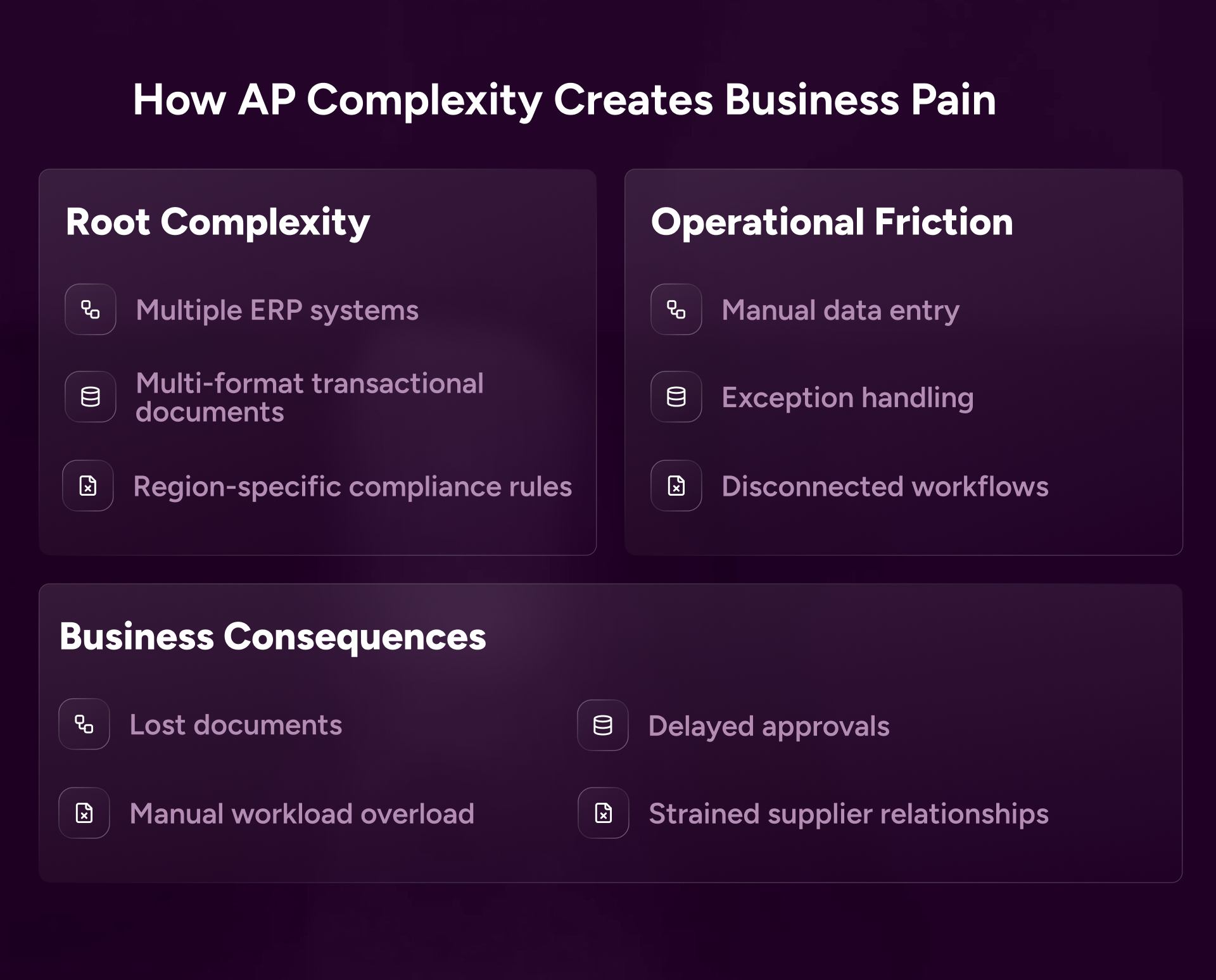
Yet many AP Managers still face a familiar struggle: manual work, disconnected workflows, lost B2B documents, and delayed approvals. These challenges persist in environments where finance operations remain fragmented and overly dependent on human intervention.
The mandate is clear:
- ️Automate end-to-end enterprise document processing
- Reduce manual data entry and exceptions
- Streamline supplier communications
- Improve vendor relationships and productivity
But here’s the next frontier: building connected vendor ecosystems that go beyond efficiency to enable collaboration, transparency, and long-term resilience.
Why Traditional AP Models Are Breaking Down
Today’s AP teams operate in increasingly complex environments:
- Multiple ERP systems
- Multi-format transactional documents
- Region-specific compliance and tax rules
When systems and data flows are not digitally aligned, finance teams spend disproportionate time on exception handling, reconciliation, and follow-ups instead of value-added work. Over time, this leads to operational friction, delayed approvals, and strained supplier relationships.
For AP leaders, this is the wake-up call. It’s no longer just about processing documents faster, it’s about creating a resilient operating model that connects people, processes, and data across the organisation.
How to Build a Vendor Ecosystem-Centric AP Model
Forward-looking AP leaders are redefining success. They’re shifting from “faster document processing” to smarter ecosystem orchestration.
Today, Accounts Payable is no longer measured only by speed or volume. Modern AP teams are expected to connect suppliers, procurement, finance systems, and ERPs into a cohesive operating model where data flows seamlessly and decisions happen with minimal friction. Every enterprise document becomes part of a broader ecosystem that supports accuracy, compliance, and real-time visibility.
This approach aligns with the broader concept of business ecosystems, where interconnected participants operate together to create shared value. Business concept from Wikipedia describes business ecosystems as networks of organizations, partners, and stakeholders that collaborate and evolve together to drive mutual value creation.
In this model, AP functions as a strategic connector between upstream purchasing activities and downstream payments and reporting. Success is defined by fewer exceptions, reduced disputes, predictable cash flow, and the ability to scale operations without increasing manual effort - turning AP from a transactional unit into a driver of operational and financial resilience.
Automate with Purpose – Unify the Document Lifecycle
Automation in AP is not about replacing people; it’s about removing friction from the document lifecycle.
A modern AP automation approach should:
- Auto-capture documents from any format or channel
- Extract and validate critical data using intelligent logic
- Enable touchless approvals through rule-based workflows
- Prevent errors and duplicates through automated validations
When automation is applied across the entire lifecycle, AP teams gain accuracy, consistency, and audit readiness while reducing dependency on manual effort. This emphasis on standardised, repeatable processes closely aligns with the principles of ISO 9001 quality management systems, which focus on process consistency, governance, and continuous improvement in enterprise operations. Quality management fundamentals from ISO explain that structured, process-driven systems help organizations deliver consistent outcomes, maintain compliance, and drive ongoing performance improvement.
Strengthen Supplier Collaboration Through Visibility
In a vendor ecosystem model, supplier communication should not depend on email threads or manual follow-ups.
When suppliers have real-time visibility into document and payment status, AP teams experience fewer inbound queries, faster dispute resolution, and stronger vendor relationships. Transparency shifts AP from being perceived as a bottleneck to becoming a trusted partner within the supplier network.
Align AP and Procurement to Maximise Strategic Value
Vendor ecosystems perform best when AP and Procurement operate on shared data and aligned workflows.
When purchase documents, receipts, and payments remain connected throughout the transaction lifecycle, organisations benefit from reduced duplication, improved compliance, and better cash flow predictability. This alignment strengthens supplier trust while enabling finance teams to operate with greater control and confidence.
Turning Data into Decisions: The Power of Analytics
AP systems generate large volumes of transactional data. When structured and interpreted effectively, this data enables AP Managers to move from reactive processing to strategic decision-making.
Analytics empower teams to identify bottlenecks, monitor supplier performance, improve forecasting accuracy, and anticipate potential issues before they impact operations. Over time, this transforms AP into a control point for enterprise finance intelligence rather than a downstream processing function.
The Strategic Roadmap for AP Managers
To build a resilient vendor ecosystem, AP leaders should focus on four core pillars:
- End-to-End Process Automation: Eliminating manual touchpoints across workflows
- Data Connectivity: Integrating AP, Procurement, and ERP systems
- Supplier Transparency: Enabling collaboration through visibility
- Analytics and Insights : Turning transactions into forward-looking intelligence
When these elements come together, AP transitions from administrative execution to ecosystem orchestration.
The Future of AP Is Collaborative, Intelligent, and Vendor-Centric
The role of the AP Manager is evolving. Beyond processing enterprise documents, today’s leaders are responsible for enabling trust, visibility, and resilience across supplier networks.
By embracing intelligent automation, connected workflows, and data-driven insights, AP teams can achieve:
- Touchless processing
- Shorter cycle times
- Higher accuracy
- Stronger vendor relationships
- Smarter financial decisions
Building this ecosystem is not an overnight change. It’s a strategic evolution.
Ready to Reimagine Your AP Function?
Explore how intelligent document processing, smart validation, and ERP-ready integrations can help you build a next-generation AP ecosystem.
Discover how intelligent B2B document automation enables connected, future-ready Accounts Payable operations - schedule your demo today at info@coreforce.ai.
