
An invoice sits in exception queue for four days. Nobody disputes the amount, the supplier is legitimate, and the goods clearly arrived. The delay is not fraud or error; it is a 3-way match that could not reconcile a purchase order, a goods receipt, and an invoice quickly enough to move forward. This single point of friction, repeated across thousands of invoices a month, is often the real bottleneck behind a slow P2P process, more than approval workflows or supplier onboarding. 3-way match automation is the use of AI-driven document processing to validate a purchase order, goods receipt note, and invoice against each other automatically, flagging discrepancies in price, quantity, or terms before payment rather than after the fact. Framed this way, the problem is not that 3-way matching exists; it is that most organizations still perform it manually, one line item at a time.
The Known Problem: 3-Way Match Is Still a Manual Bottleneck
3-way matching exists to catch exactly the kind of discrepancy that costs money if it slips through: an extra unit billed, a price that does not match the contracted rate, or a goods receipt logged for a different quantity than the purchase order specified. Done manually, this requires an AP clerk to open three separate documents, often from three separate systems, and reconcile them line by line.
What 3-way match is actually checking for
Stripped of jargon, 3-way matching answers three questions before a single dollar is released: did we order this, did we receive this, and is this what we agreed to pay for it. Each question maps to a different document, the purchase order, the goods receipt note, and the invoice, and each has to agree with the other two before the invoice is considered clean. When any one of the three is out of sync, the invoice does not fail outright; it simply stalls, because someone now has to determine which of the three documents is wrong and why.
Why this sits at the center of the P2P process, not the edge of it
It is tempting to treat 3-way match as a back-office control rather than a process driver, but the opposite is closer to the truth. Every invoice in a P2P workflow eventually has to pass through matching before payment, which means matching speed sets a hard ceiling on how fast the entire P2P cycle can run, regardless of how efficient approvals, coding, or routing are elsewhere in the process.
McKinsey's analysis of generative AI in procurement describes exactly this shift: AI can read and interpret invoices regardless of format, then match each invoice line by line against purchase orders and contracted terms, verifying quantities, unit prices, tax, freight, and payment terms, with any discrepancy instantly flagged for review before payment goes out.
Current Gaps: Where Manual 3-Way Matching Actually Breaks Down
PO and GRN data rarely arrive in the same format
A purchase order created in one system, a goods receipt logged by a warehouse team on paper or in a separate inventory tool, and an invoice arriving as a PDF from the supplier rarely share a common structure. Manual matching means translating between formats before the actual comparison can even begin, which is where much of the four-day exception delay quietly accumulates.
Partial deliveries and split shipments break simple matching logic
A single purchase order frequently arrives in more than one shipment, particularly for bulk raw materials, seasonal inventory, or multi-location deliveries. Each partial delivery generates its own goods receipt note, and the invoice may arrive for the full order, for one partial shipment, or for a combined batch spanning several receipts. Manual reviewers have to track by hand which portion of the PO has already been received and billed, and errors here are one of the most common causes of duplicate payments and unmatched quantities.
Unit-of-measure mismatches hide in plain sight
A purchase order specifying cartons, a goods receipt logged in individual units, and an invoice billed by weight or pallet are all describing the same shipment, but a line-by-line manual comparison has to convert between these units correctly every time. A single missed conversion, such as confusing a case count with an individual unit count, can make an accurate invoice look like a mismatch, or worse, let a genuine overbilling pass through unnoticed because the units happened to look consistent on the surface.
Tolerance rules are applied inconsistently
Most manual matching processes rely on fixed tolerance thresholds, such as flagging anything more than a fixed percentage off. Applied uniformly across every vendor and category, this produces a high rate of false positives on legitimate variances and, just as often, misses genuine discrepancies that fall inside the tolerance band by coincidence.
Exceptions surface too late to act on cheaply
Because manual matching typically happens as a batch review before a payment run, discrepancies are often discovered days or weeks after the goods were received, by which point the cheapest resolution window has usually closed. A pricing error caught the day a shipment arrives can be resolved with a quick note to the supplier; the same error caught during month-end close often requires a credit memo, a reconciliation entry, and a conversation that has moved from routine to adversarial.
The exception queue becomes a parking lot, not a workflow
In most manual environments, an invoice that fails to match does not get actively worked; it gets set aside in a queue and revisited only when someone has time, which in practice often means only when a supplier calls to ask why they have not been paid. This turns 3-way match exceptions from a control step into a recurring source of supplier relationship friction, entirely avoidable if the mismatch had been visible and actionable the moment it occurred.
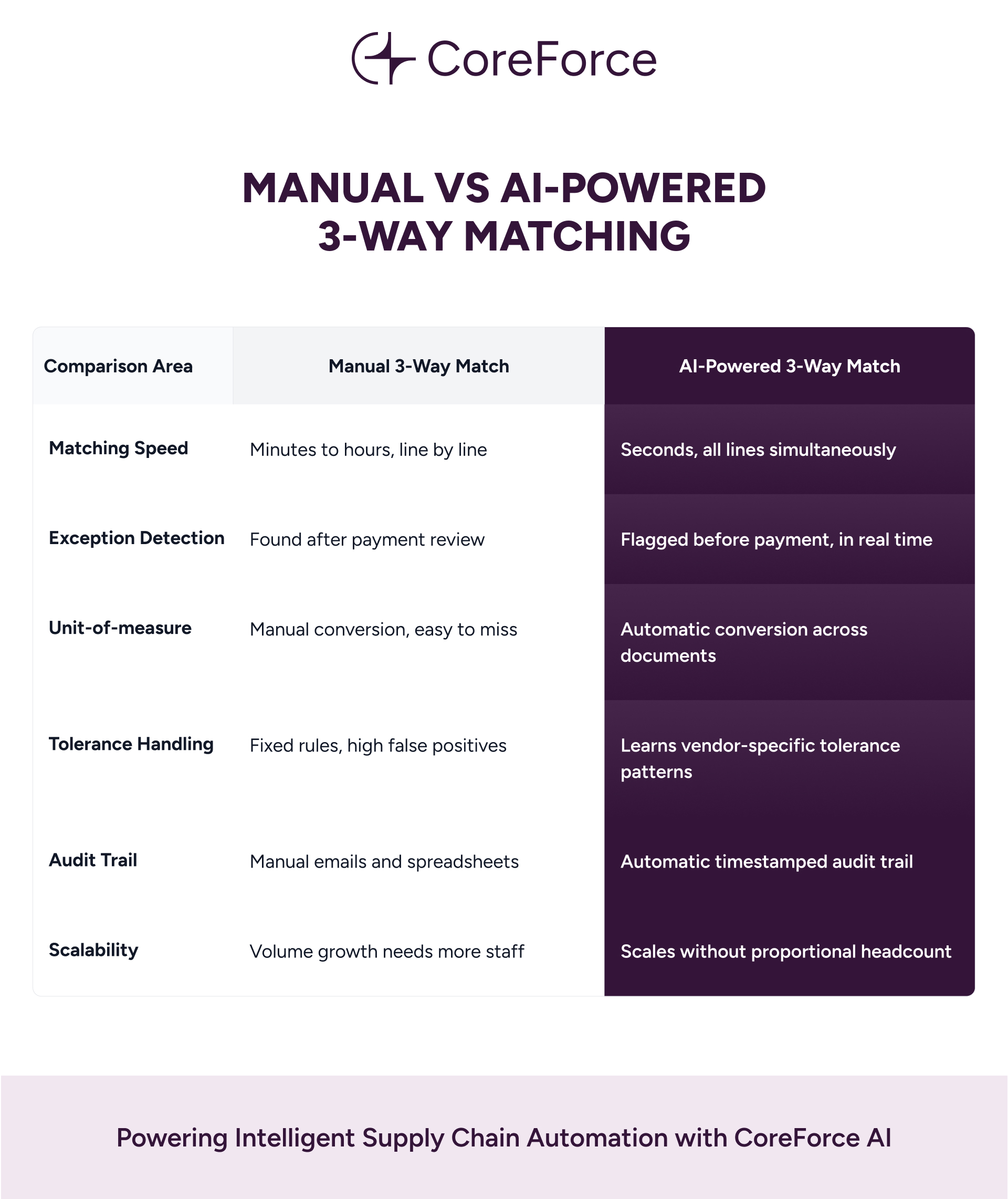
The following comparison illustrates the practical difference between manual and AI-automated 3-way matching across the dimensions that most affect AP Manager and Procurement Head priorities.
What AI Changes in 3-Way Match Automation
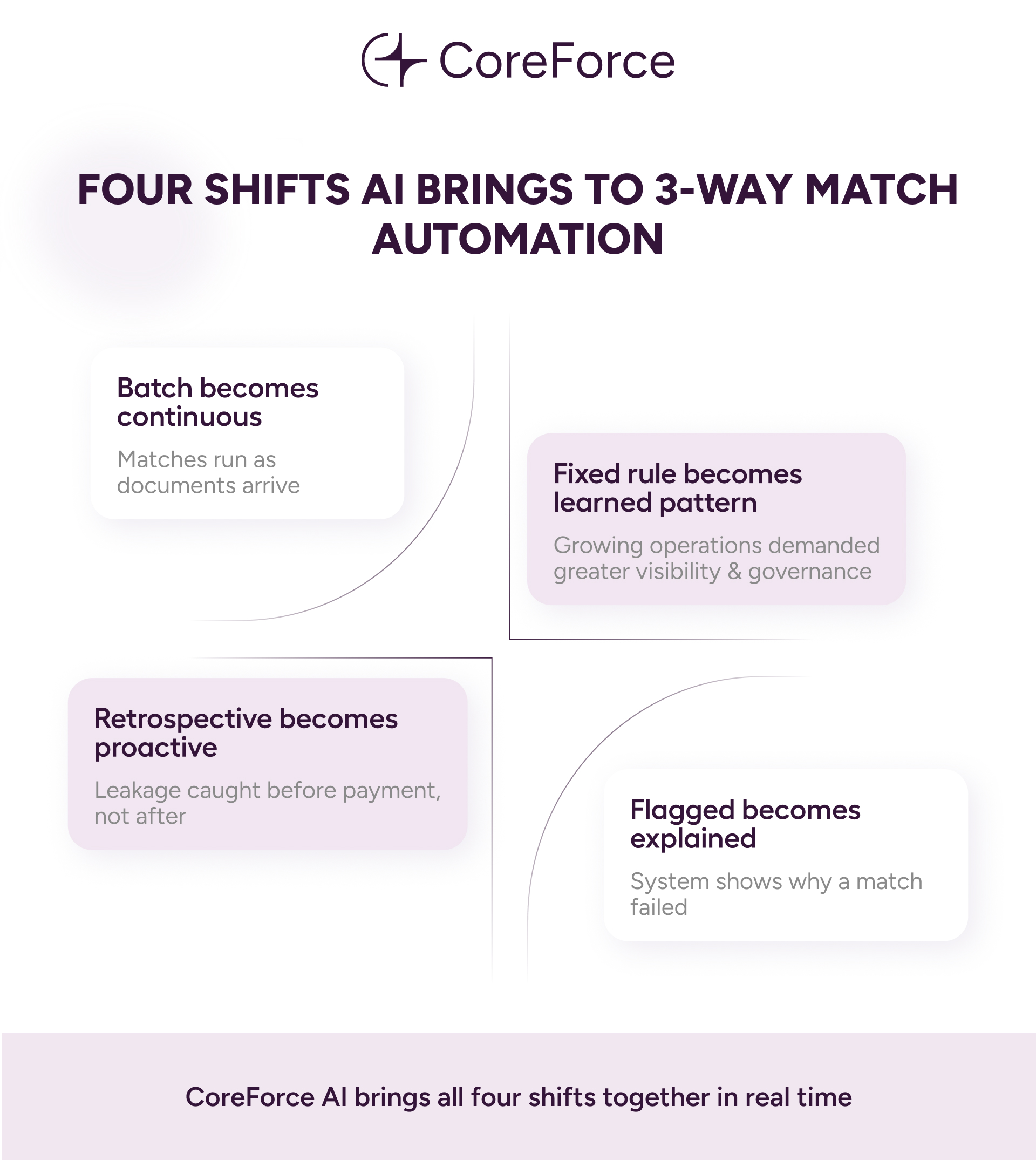
AI-based 3-way match automation does not simply speed up the same manual comparison; it changes what is possible to check. Rather than validating three documents against each other in isolation, the system can validate against contracted terms, historical vendor patterns, and ERP data simultaneously, catching discrepancies that a manual reviewer working from three static documents would not have context to notice.
Matching moves from batch to continuous
Manual matching is inherently a batch activity: documents accumulate, then someone sits down and works through them in a session. AI-based matching runs continuously as each document arrives, so a mismatch between a goods receipt and an invoice is visible within minutes of the invoice landing, not at the next scheduled review cycle. This alone removes most of the artificial delay that has nothing to do with the complexity of the discrepancy itself and everything to do with when a human happened to look at it.
Tolerance logic becomes a learned pattern, not a fixed rule
Instead of applying one tolerance percentage to every vendor and category, an AI-based system can learn that a particular supplier consistently rounds freight charges a certain way, or that a specific commodity category has naturally wider price variance due to market fluctuation, and adjust what counts as an exception accordingly. This reduces false positives without loosening genuine controls, because the tolerance is specific to the actual pattern rather than a single number applied everywhere.
Discrepancies are explained, not just flagged
A meaningful difference between basic automation and true AI-based matching is explainability. Flagging a mismatch is only half the job; a system that also surfaces why it does not match, for example, a quantity that ties back to a specific partial delivery, or a price that ties back to a specific amendment on the purchase order, means the AP team spends its time resolving the exception instead of first diagnosing it.
Value recovery becomes proactive rather than retrospective
A McKinsey analysis of procurement value leakage found that one global pharmaceutical company's AI-based invoice-to-contract reconciliation tool, developed as a proof of concept in four weeks, identified more than 10 million dollars in value leakage, prompting supplier renegotiations to recover the lost value directly. The shift this represents is structural: instead of a periodic recovery audit finding overpayments months after the fact, the matching system catches the same class of error before the invoice is ever paid.
Evaluation Criteria: What to Look for in a 3-Way Match Automation Solution
- ERP-agnostic matching, so the tool works across existing systems rather than requiring a single-ERP environment.
- Support for multilingual and non-standard PO formats, including HTML-format and handwritten purchase orders.
- Real-time exception flagging before invoices enter the payment queue, not batch review after the fact
- Configurable, vendor-specific tolerance logic rather than one fixed threshold applied to all suppliers.
- Native handling of partial deliveries and split shipments, so a PO spread across multiple GRNs still matches correctly.
- Automatic unit-of-measure conversion between purchase orders, receipts, and invoices.
- A complete, automatically generated audit trail for every match decision, supporting SOX and internal audit requirements.
Why PO compliance and supplier risk belong in this evaluation
For Procurement Heads specifically, PO compliance and supplier risk sit directly behind these evaluation criteria: a 3-way match automation tool that can also flag maverick spend or off-contract pricing at the point of match extends the value of the investment beyond AP into procurement governance. A mismatch is not only a payment accuracy issue; repeated mismatches from the same supplier are often an early signal of a supplier relationship, a contract, or an internal buying pattern that needs closer attention.
Why implementation fit matters as much as feature fit
Two solutions can score identically against the criteria above and still perform very differently in practice, depending on how well they integrate with the specific ERP, document formats, and approval hierarchy already in place. Asking a vendor to demonstrate matching against a sample of the organization's own historical exception cases, rather than a generic demo dataset, is one of the more reliable ways to separate genuine fit from a feature checklist match.
The Business Case for Fixing 3-Way Match Now
The cost of a slow 3-way match process is rarely visible on its own; it shows up as extended cycle times, missed early payment discounts, and AP headcount that scales with invoice volume rather than staying flat. Each of those costs compounds quietly until a CFO asks why cost per invoice has plateaued despite continued investment in automation elsewhere.
The cash flow case
Invoices stuck in a 3-way match exception queue cannot be paid, which means early payment discounts tied to prompt payment terms are lost by default, not by choice. At scale, a few percentage points of missed discount across a large annual spend base is a recurring, entirely avoidable cost that shows up nowhere on a P2P dashboard focused only on cycle time.
The headcount and scalability case
A manual matching function scales roughly linearly with invoice volume: doubling invoice volume without doubling the matching team simply means a longer exception queue and slower resolution. Automated matching decouples volume growth from headcount growth, which becomes increasingly material as an organization adds suppliers, entities, or geographies without a corresponding increase in AP capacity.
The audit and compliance case
Every manually resolved exception represents a judgment call that has to be reconstructed later if an auditor asks why a particular invoice was approved despite an apparent mismatch. An automated system that logs the match decision, the data it compared, and the tolerance applied at the moment of the decision removes this reconstruction burden and gives Risk and Compliance a defensible, timestamped record by default.
CoreForce's document processing platform performs 3-way and n-way matching across purchase orders, goods receipts, and invoices in real time, with configurable tolerance logic by vendor and category, so exceptions are caught and routed before they ever reach the payment queue.
Conclusion
A slow P2P process is usually not a workflow or approval problem; it is a matching problem, hiding in the gap between a purchase order, a goods receipt, and an invoice that were never designed to reconcile with each other automatically. Fixing 3-way match automation addresses the bottleneck at its source rather than adding another layer of process on top of it.
CoreForce built its matching engine specifically to close this gap, validating purchase orders, goods receipts, and invoices in real time so AP teams stop discovering discrepancies after the fact.
Schedule your demo today at info@coreforce.ai.
Frequently Asked Questions
What is 3-way match automation?
3-way match automation is the use of AI to validate a purchase order, goods receipt note, and invoice against each other automatically, flagging discrepancies in price, quantity, or terms before payment is released.
Why does 3-way matching slow down the P2P process?
Manual 3-way matching requires an AP clerk to compare three separate documents line by line, often in different formats, which creates delays especially when purchase order or goods receipt data does not match the invoice cleanly.
What is the difference between 2-way and 3-way matching?
2-way matching compares a purchase order to an invoice only, while 3-way matching adds the goods receipt note, confirming that what was ordered, received, and billed all agree before payment.
Can 3-way match automation work with an existing ERP system?
Yes. An ERP-agnostic document processing layer can validate purchase orders, goods receipts, and invoices and then export the matched data into the existing ERP, without requiring a system replacement.
How much of the invoice exception backlog does 3-way match automation typically reduce?
The specific reduction depends on baseline exception rates and document complexity, but organizations moving from manual to automated matching consistently report faster exception discovery and materially fewer invoices held in queue at any given time.
