
The Pressure of Predictable Cash Flow
If you’re leading Accounts Receivable today, you’re likely balancing competing priorities - keeping customers happy, ensuring on-time collections, managing exceptions, and maintaining visibility across fragmented systems. Every delayed payment or disputed business document ripple across the organization, putting pressure on cash predictability and working capital.
As finance teams face increasing expectations for real-time visibility and faster cycles, the AR function plays a critical role in determining how reliably cash moves through the business. Cash flow optimization is no longer just an operational goal; it has become a strategic requirement tied directly to liquidity, forecasting accuracy, and long-term growth. Clear understanding of accounts receivable fundamentals plays a central role in this shift, as explained in Investopedia’s overview of Accounts Receivable.
Why AR Teams Struggle to Maintain Flow
Many AR teams operate in reactive mode. Manual processes, disconnected systems, and inconsistent data inputs make it difficult to maintain a single source of truth for receivables. These gaps lead to billing errors, delayed dispute resolution, and rising Days Sales Outstanding.
Foundational finance principles around receivables management consistently show that delayed invoicing, weak visibility, and poor data quality are among the most common contributors to unpredictable cash flow and working capital strain. When AR lacks structure and insight, teams spend more time chasing payments than actively managing cash outcomes, directly impacting overall cash flow health as outlined in Corporate Finance Institute’s explanation of cash flow and working capital.
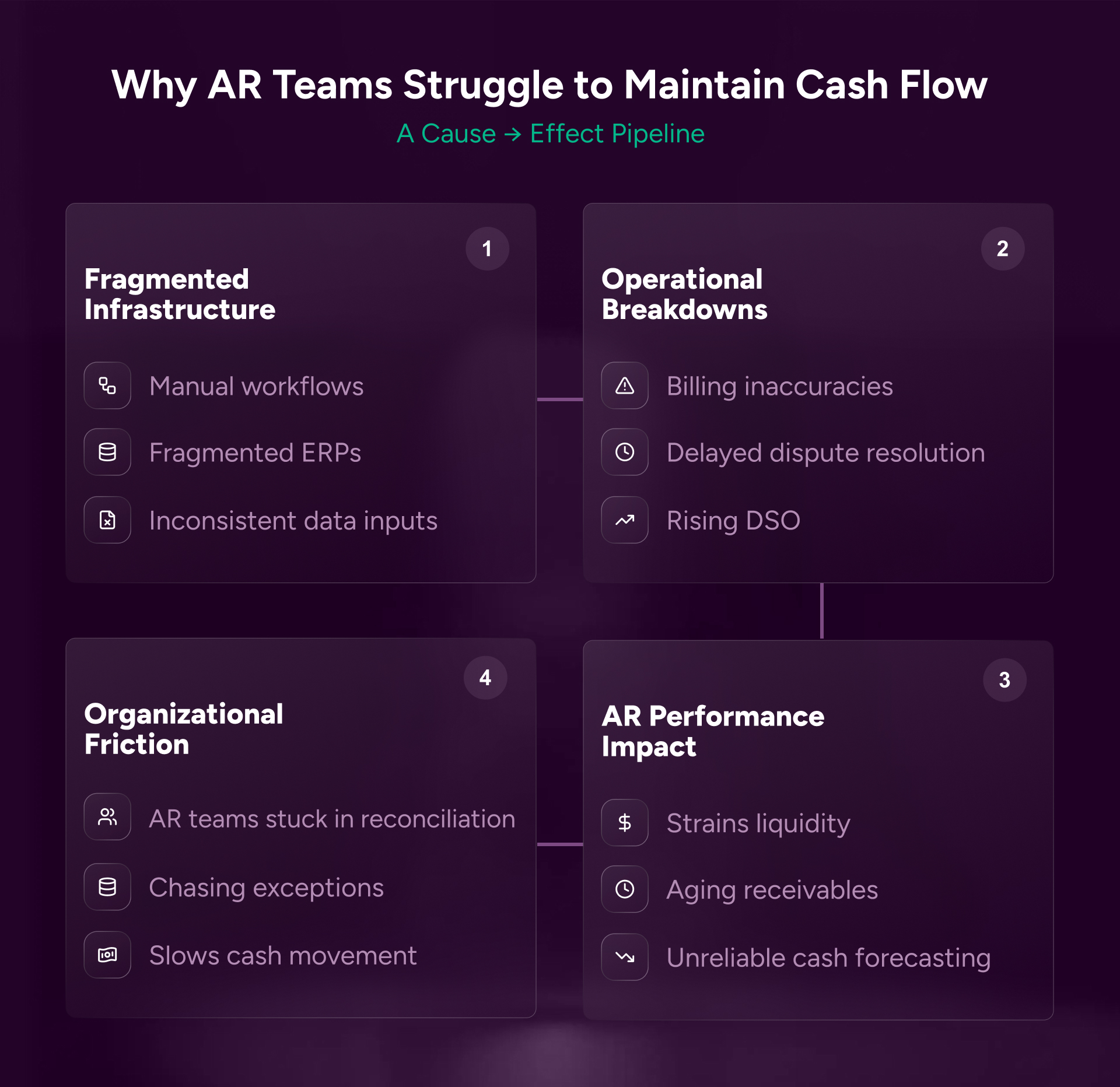
These inefficiencies don’t just slow collections. They weaken alignment across sales, finance, and operations, creating friction around accountability and performance.
Turning AR Into a Strategic Growth Enabler
Accounts Receivable becomes a true growth driver when it evolves from a reactive, transactional function into a proactive, insight-led operation. This transformation is powered by automation that removes manual friction, data accuracy that builds trust across stakeholders, and intelligent controls that deliver real-time visibility into receivables performance and risk.
When AR operates with consistent data and standardized processes, it gains credibility across finance, sales, and leadership teams. Decision-making improves as exceptions decline, disputes reduce, and cash outcomes become more predictable rather than reactive. This predictability is closely tied to stronger cash flow management discipline, a core principle in modern finance education.
With these foundations in place, AR teams can actively shape cash flow outcomes, strengthen cross-functional alignment, and contribute directly to financial resilience and sustainable growth.
AR Automation for Predictability
Automating routine AR activities such as invoicing, payment tracking, and follow-ups reduces cycle times and improves consistency. Modern finance frameworks position automation as a key enabler of faster cash conversion and more reliable forecasting, helping organizations move from reactive collection to proactive cash planning.
Automation also minimizes dependency on manual interventions, which are often a source of delays and inconsistencies. By standardizing workflows and enforcing rules consistently, AR teams can improve forecast accuracy and reduce volatility in cash inflows. As a result, leadership gains greater confidence in short- and medium-term cash projections.
Document Accuracy for Faster Payments
Invoice and document errors remain one of the leading causes of delayed payments. Improving document accuracy at the source reduces disputes, prevents rework, and accelerates collections. Strong upstream data quality directly supports healthier cash conversion cycles and improved working capital performance.
Accurate documents also improve customer trust and reduce back-and-forth communication that slows payment timelines. When invoices are clear, complete, and aligned with contractual terms, customers are more likely to process payments on time. Over time, this consistency leads to lower DSO and fewer revenue leakages.
Establishing Best Practices
High-performing AR teams rely on standardized workflows, clear accountability, and continuous monitoring. Accepted finance best practices emphasize visibility, exception control, and tight integration across the order-to-cash lifecycle to maintain predictable and resilient cash flow.
Clear ownership of processes ensures faster resolution of issues, while defined escalation paths prevent delays from lingering unresolved. Standard operating models also make AR operations more scalable as volumes grow. Together, these practices create a disciplined foundation for sustained cash performance.
From Data to Insight: Making Every Decision Count
Modern AR teams rely on real-time insights rather than static reports. Integrated dashboards enable leaders to track DSO trends, identify risk-prone customers, and forecast collections with greater confidence.
Finance education consistently shows that organizations with strong visibility into receivables and cash metrics are better positioned to anticipate liquidity gaps, manage working capital, and respond effectively to volatility. Advanced insights also allow teams to identify patterns early, such as repeat dispute causes or delayed payer segments. With the right insights, AR leaders move from reporting historical outcomes to actively influencing future cash performance.
Building the Foundation for Sustainable Cash Flow
Sustainable cash flow optimization is not a one-time initiative. It requires continuous improvement across processes, data governance, and controls. Automating reconciliation, cash application, and exception handling helps reduce friction while improving customer experience.
Consistency in execution plays a critical role in sustaining gains over time. As processes mature, organizations experience fewer disruptions and more stable cash inflows. Core finance learning reinforces that predictable cash flow is built on accurate data, structured processes, and proactive management rather than reactive recovery.
The Strategic Case for AR Automation
Beyond efficiency gains, AR automation supports broader financial resilience. Faster collections, lower bad-debt exposure, and improved visibility help organizations manage uncertainty and protect liquidity during periods of economic volatility.
By strengthening control and predictability, AR automation also supports strategic planning, investment decisions, and long-term growth initiatives.
The Next Step in Your AR Transformation
At CoreForce, we help finance teams reduce document friction, improve data accuracy, and gain control over receivables through intelligent B2B document automation. By removing manual bottlenecks and strengthening visibility, AR teams can achieve faster collections and more predictable cash flow.
CoreForce enables AR leaders to shift focus from operational firefighting to proactive cash management by ensuring business documents are captured, validated, and aligned with downstream finance systems. This results in fewer disputes, cleaner data, and stronger confidence in receivables outcomes across the organization. Book a demo today only at info@coreforce.ai .
