
Introduction: Why Accounts Payable Can No Longer Be Reactive
How much time does your Accounts Payable team spend correcting errors that could have been avoided?
Traditional Accounts Payable operations are built to react. Errors are identified after invoices are received, exceptions are handled once issues surface, and processing delays are accepted as part of the workflow. As invoice volumes increase and formats become more complex, this reactive approach directly limits error reduction, slows approvals, and prevents faster invoice processing.
McKinsey industry research shows that finance teams adopting AI and advanced analytics are shifting from retrospective processing to proactive, data-led decision-making.
Predictive Accounts Payable changes this model. By using historical data, pattern recognition, and intelligent workflows, AP teams can anticipate where errors are likely to occur, intervene earlier, and keep invoices moving without unnecessary rework. This article explains how predictive AP enables error reduction, accelerates invoice processing, and supports more consistent cash flow outcomes through data-driven decision-making.
The Cost of Errors in Traditional Invoice Processing
Invoice errors rarely occur in isolation. A small mismatch in pricing, quantity, or tax calculation can trigger manual reviews, exception queues, and repeated follow-ups.
Common challenges in traditional AP environments include:
- Late identification of invoice errors.
- High dependence on manual validation.
- Rework caused by inconsistent data.
- Approval delays driven by unresolved exceptions.
These issues not only reduce processing efficiency but also make faster invoice processing difficult to achieve at scale. Without early visibility into where errors originate, AP teams are forced to spend time fixing problems instead of preventing them.
How Predictive Accounts Payable Enables Error Reduction
Predictive Accounts Payable uses data from past invoices, exceptions, and processing patterns to identify risk before invoices stall in the workflow. Instead of waiting for discrepancies to surface, predictive models highlight invoices that are likely to fail validation.
This approach enables:
- Early error identification based on historical patterns.
- Proactive error detection before approvals is delayed.
- Invoice accuracy improvements through continuous learning.
- Exception reduction by addressing root causes.
By shifting from reactive correction to proactive prevention, predictive AP delivers sustainable error reduction while reducing manual effort.
The Role of Invoice Processing Automation in Predictive AP
Predictive AP does not replace automation. It builds on it.
Invoice processing automation ensures invoices are captured, extracted, and validated consistently. Predictive intelligence then analyzes this data to anticipate where issues are most likely to occur.
A PWC finance transformation research positions automation as the foundation layer that enables advanced analytics and predictive decision-making.
Together, they enable:
- Invoice validation rules applied consistently across invoices.
- Automated data extraction from varied invoice formats.
- Predictive analytics in AP to flag anomalies early.
- Reduced manual intervention for clean invoices.
This combination allows AP teams to achieve faster invoice processing without sacrificing control or accuracy.
From Reactive Processing to Predictive Control in Accounts Payable
Traditional AP workflows are designed to respond once problems surface. Errors are identified after invoices enter approval queues, exceptions are handled when delays occur, and teams rely heavily on manual intervention to keep processing moving.
This reactive operating model typically results in:
- Errors surfacing late in the workflow, increasing rework.
- Exceptions becoming the primary driver of AP effort.
- Manual reviews slowing overall invoice throughput.
- Limited ability to anticipate delays or cash flow impact.
As invoice volumes grow, this approach makes both error reduction and faster invoice processing difficult to sustain.
How Predictive AP Changes the Operating Model
Predictive Accounts Payable introduces a shift from reaction to anticipation. By analyzing historical invoice data, exception patterns, and validation outcomes, predictive AP identifies risk early and adjusts processing paths accordingly.
With predictive control in place:
- Potential errors are identified before invoices reach approval stages.
- High-risk invoices are flagged or routed for early attention.
- Low-risk invoices progress with minimal or no manual touch.
- Processing bottlenecks are anticipated rather than discovered.
This shift enables consistent error reduction, improves invoice accuracy, and supports faster invoice processing without increasing operational overhead.
Why This Shift Matters
The value of Predictive AP lies not just in automation, but in foresight. When AP teams can anticipate where errors and delays are likely to occur, they spend less time fixing issues and more time managing performance.
This transition from reactive processing to predictive control is what allows Accounts Payable to scale efficiently while supporting more predictable cash flow outcomes.
How Does Predictive AP Support Faster Invoice Processing?
Predictive AP accelerates processing by removing friction before it disrupts workflows.
Key contributors include:
- Proactive exception management that prevents bottlenecks.
- Early anomaly detection based on invoice patterns.
- Reduced rework through higher invoice accuracy.
- Shorter approval cycle times enabled by clean data.
When fewer invoices enter exception queues, processing capacity increases naturally, supporting sustained speed improvements.
Operational Metrics Improved by Predictive AP
Organizations adopting Predictive Accounts Payable typically measure success through a defined set of operational performance indicators. These metrics capture how predictive insights and automation combine to reduce errors, accelerate processing, and stabilize approval timelines.
- Error reduction rate: Fewer invoices requiring correction or reprocessing.
- Invoice processing speed: Faster movement from receipt to approval.
- Exception frequency: Lower volume of invoices requiring manual intervention.
- Touchless processing rate: Higher percentage of invoices processed end-to-end automatically.
- Cost per invoice: Reduced handling effort across AP operations.
- Approval cycle time consistency: More predictable processing timelines with fewer delays.
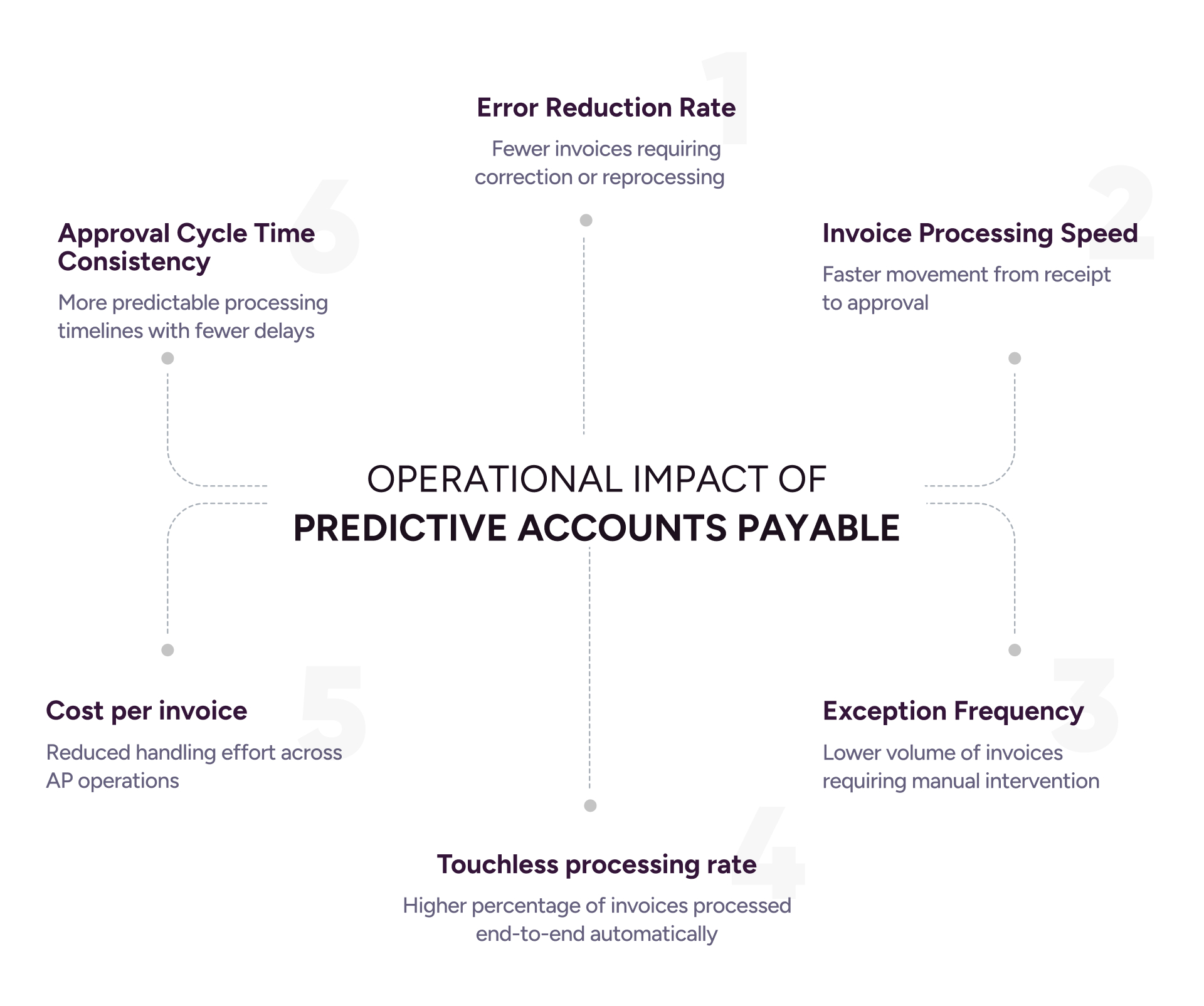
Fig - Predictive Accounts Payable: Advancing Invoice Processing with Data-Led Intelligence
These metrics reflect the combined impact of predictive insights and automation across the Accounts Payable workflow.
Predictive AP and Cash Flow Optimization
Cash flow optimization depends on timing, accuracy, and predictability. When invoices are delayed due to errors or rework, payment schedules become reactive.
By improving invoice accuracy, reducing exceptions, and enabling faster invoice processing, predictive AP supports:
- More predictable payment cycles.
- Better working capital visibility.
- Reduced payment delays caused by processing issues.
Predictive AP helps AP teams move from firefighting to forward planning.
Conclusion: Moving from Error Correction to Error Prevention
Reactive AP processes were designed for a simpler time. Today’s invoice volumes and complexity demand a different approach.
Predictive Accounts Payable enables organizations to anticipate errors, reduce manual intervention, and achieve faster invoice processing through intelligent use of data. By combining invoice processing automation with predictive analytics, AP teams can reduce exceptions, improve accuracy, and support more reliable cash flow outcomes.
CoreForce enables Predictive AP by combining AI-driven document processing, predictive insights, and automated workflows into a unified platform. This helps organizations reduce errors before they occur and accelerate invoice processing at scale.
To learn more about how CoreForce supports Predictive Accounts Payable and data-driven invoice processing, schedule your demo today at info@coreforce.ai.
